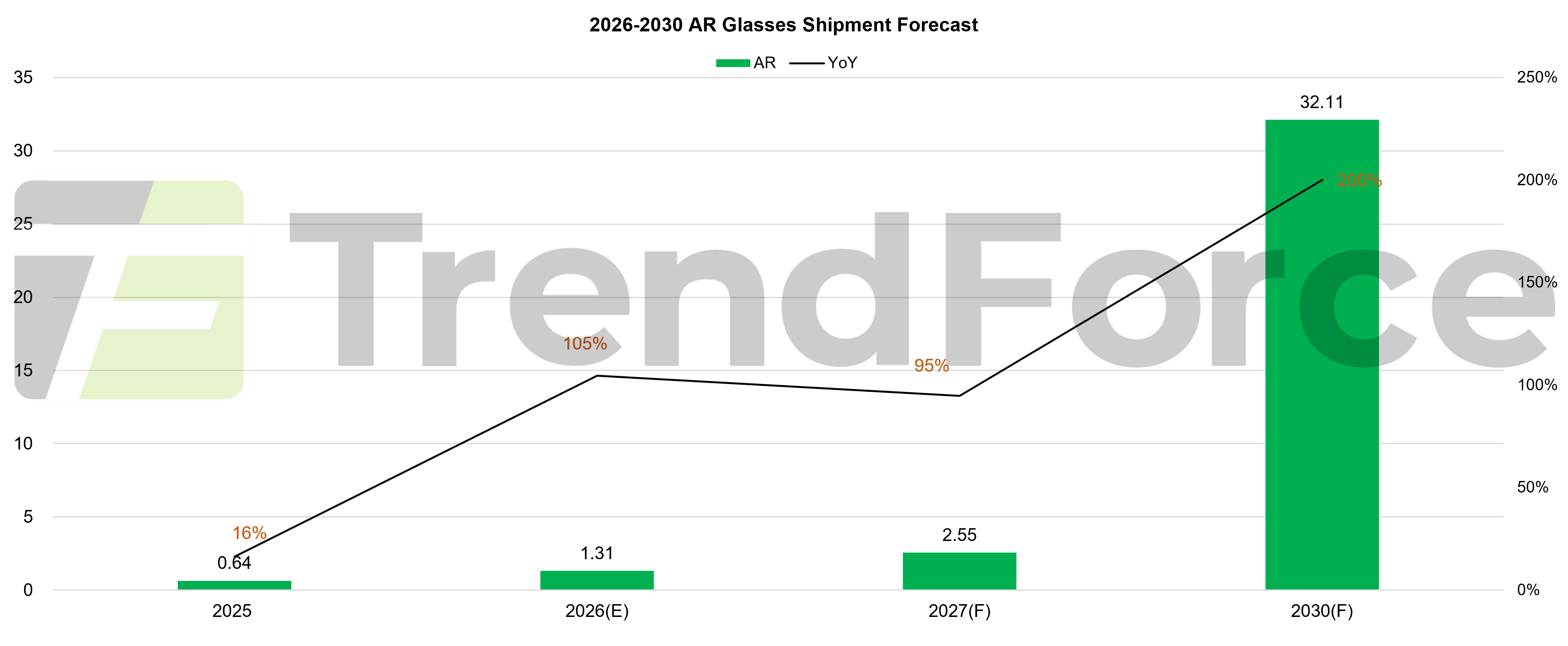
According to “2026 Near-Eye Display Market Trend and Technology Analysis”, global AR glasses shipments are expected to surpass the one-million-unit milestone in 2026, reaching 1.31 million units, representing 118.2% YoY growth, and are projected to increase to 32.11 million units by 2030. As brands accelerate their product development and market expansion, three major trends are emerging: product positioning differentiation, system-level design optimization, and AI ecosystem integration. These developments are driving technological innovation, cost optimization, and production capacity expansion across the optical engine and optical waveguide supply chains.
Brand Diversification Drives Market Expansion
From a competitive landscape perspective, Meta is expected to maintain its leading position in the global AR glasses market in 2026, accounting for approximately 20% of total shipments, supported by the market performance of its Meta Ray-Ban Display. The other four leading brands—XREAL, Even Realities, Rokid, and RayNeo—are projected to collectively account for 53.2% of global shipments. This indicates that brands beyond Meta have gradually established a substantial market presence, expanding the consumer base and application scenarios for AR glasses through differentiated product positioning and sales strategies.
In terms of microdisplay technology adoption, LEDoS and OLEDoS are each expected to account for approximately 40% of AR glasses shipments in 2026, while LCoS represents around 20%. This distribution indicates that no single display technology has established a dominant position, with different technologies evolving to address specific product positioning, optical architectures, and application requirements.
AI Ecosystem Integration Drives AR Glasses Application Upgrades
Notification-type AR glasses continue to evolve toward lighter designs, improved wearing comfort, lower power consumption, and full-color displays. While maintaining lightweight form factors, brands are expected to enhance the richness of displayed information and overall user experience, gradually strengthening the value proposition of AR glasses for everyday use. Meanwhile, immersion-type AR glasses are expanding beyond conventional large-screen entertainment toward sensor integration, spatial positioning, and spatial computing applications, creating new opportunities for multitasking, virtual-real interaction, and immersive experiences.
At the same time, as AI agents, operating systems, and application services continue to mature, competition among AR glasses brands is increasingly extending toward their ability to integrate Hardware × AI Model × OS × Application × Ecosystem. This trend is expected to unlock broader possibilities for AI applications, which will, in turn, drive demand for enhanced display capabilities and upgraded hardware specifications, further expanding market growth opportunities.

Supply Chain Diversification Becomes a Key Development Priority
As the AR glasses market expands, competition among microdisplay technologies is increasingly extending beyond display performance to encompass supply chain diversification, manufacturing yields, cost control, and system-level integration capabilities. LEDoS, LCoS, and OLEDoS are leveraging their respective technological advantages and supply chain strategies to address the differentiated requirements of AR glasses.
First, supply chain expansion and full-color development will become the two major priorities for LEDoS. Monochrome green LEDoS has already established a stable mass-production foundation, making it an important display solution for notification-type AR glasses. As end applications gradually evolve from monochrome information display toward richer visual content, dual-color and full-color LEDoS technologies continue to advance.
From a supply chain perspective, although Jade Bird Display (JBD) currently maintains a dominant position in the LEDoS market, suppliers including ams OSRAM, Ennostar, Hongshi Intelligence, and Innovision are actively investing in technology development and expanding their presence in brand supply chains. As the supplier base grows, brands will gain access to more design options and alternative sourcing channels, improving supply chain flexibility, reducing dependence on individual suppliers, and optimizing cost structures through increased market competition.
Over the medium to long term, full-color LEDoS will be an important technological direction for expanding AR glasses applications. However, achieving an optimal balance among high brightness, low power consumption, color performance, manufacturing yield, and cost will remain critical in determining its mass-production scale and market penetration.
Second, LCoS benefits from mature full-color display technology, semiconductor manufacturing processes, and an established supply chain, making it particularly suitable for products requiring comprehensive color reproduction and rich information display capabilities. With continued advancements in front-lit, non-PBS, and innovative optical architectures, LCoS optical engines are evolving toward smaller form factors and higher optical efficiency, addressing the size and weight limitations of conventional LCoS designs.
Major suppliers include Himax and OmniVision. As optical engine designs continue to improve, LCoS is expected to maintain its competitive advantages in the full-color information-display AR glasses market.
Third, OLEDoS offers mature full-color display capabilities and high resolution, making it widely adopted in immersion-type AR glasses that emphasize audiovisual entertainment and immersive experiences. As market requirements for display resolution, brightness, and image quality continue to increase, OLEDoS development is progressing toward higher brightness and resolution.
From a supply chain perspective, Sony continues to maintain an important position in the premium market through its mature OLEDoS manufacturing processes and strong product performance. Meanwhile, suppliers such as SeeYA and SidTek are gradually expanding their market presence, providing brands with more diversified sourcing options.
Deeper Collaboration Between Optical Waveguide Suppliers and Brands Becomes Critical
As AR glasses increasingly target everyday wear and the consumer market, competition in optical waveguide technology is expanding beyond field of view (FoV) and optical efficiency to encompass overall optical performance, including lens thickness, weight, uniformity, rainbow-effect suppression, and wearing comfort.
In particular, the microstructure design and manufacturing capabilities of surface relief gratings (SRG) are becoming critical factors influencing product performance and mass-production competitiveness. Manufacturing processes such as nanoimprint lithography (NIL), deep ultraviolet lithography (DUV), and etching can be combined according to the structural requirements of different grating profiles, including blazed, slanted, and multi-step structures.
Companies such as Goertek Optical, SEEV, North Ocean Photonics, and Applied Materials are advancing the industry through optical design, manufacturing technologies, and module integration. Among these processes, NIL offers advantages in replication efficiency and mass-production costs but continues to face limitations related to material refractive indices and the long-term stability of organic materials. DUV and etching processes, meanwhile, provide different levels of structural precision and material compatibility. Looking ahead, the ability to integrate hybrid manufacturing processes will become increasingly important for suppliers seeking greater microstructure design flexibility and improved production yields.
In addition, emerging optical technologies such as metasurfaces and polarization volume gratings (PVG) continue to expand potential applications. Metasurfaces offer a high degree of microstructure design freedom, creating opportunities to enhance optical component integration, optical efficiency, and imaging quality. PVG, meanwhile, leverage polarization selectivity and volume grating characteristics to explore improvements in optical coupling efficiency and simplified optical path architectures, providing additional technological pathways for future optical waveguide development.
As the interdependence among optical engines, optical waveguides, and overall device structures increases, optical waveguide suppliers will need to become involved earlier in brands' product development processes. Through early-stage collaborative design, suppliers and brands can achieve a better balance among optical efficiency, display quality, weight, and wearing comfort.
Consequently, suppliers with diversified microstructure manufacturing capabilities, strong mass-production yield control, and system integration expertise will be better positioned to deepen partnerships with brands, establish long-term competitive advantages, and strengthen their roles within the AR glasses supply chain as the market expands.

AI Applications and Optical Technologies Reinforce Each Other, Making 2027 a Pivotal Year for AR Glasses Market Expansion
Overall, the AR glasses industry is developing a mutually reinforcing growth cycle driven by market demand, AI ecosystems, and optical supply chains. As product positioning becomes increasingly differentiated and AI applications continue to expand, demand for full-color displays, higher optical efficiency, and improved system-level specifications will accelerate.
From a supply chain perspective, the development of optical engines emphasizes supply chain breadth, with new suppliers, manufacturing innovations, and expanded production capacity providing brands with greater technological flexibility and cost control. Optical waveguides, in contrast, place greater emphasis on collaboration depth, as early-stage co-design between brands and suppliers becomes essential to improving optical quality and wearing comfort. Together, these trends reflect the industry's gradual transition toward competition centered on overall system optimization and supply chain integration capabilities.
According to TrendForce, as technology giants including Meta, Google, Samsung, and Apple continue to advance their product strategies, alongside improvements in optical technology maturity and cost structures, AR glasses are expected to accelerate their penetration into the consumer market, laying the foundation for global shipments to reach 32.11 million units by 2030.
TrendForce's “2026 Near-Eye Display Market Trends and Technology Analysis” covers brand shipment forecasts, microdisplay and optical waveguide technology pricing analysis, optical engine pricing and cost analysis, and supplier developments, providing comprehensive insights to support product marketing strategies across the near-eye display industry.
Author : Emerson, Estelle / TrendForce
TrendForce 2026 Near-Eye Display Market Trends and Technology Analysis
Publication Date: November 30, 2026
File Format: PDF
Available Languages: Mandarin Chinese / English
Chapter I. Near-Eye Display Devices Market Analysis
-
2026-2030 NED Devices Shipment Analysis
-
2026-2030 VR/MR Devices Shipment Analysis
-
2026-2030 VR/MR Devices Market Share by Technology
-
2026-2030 AR Glasses Shipment Analysis
-
2026-2030 AR Glasses Market Share by Technology
-
2026 AR Glasses Shipment Ranking by Brand & Market Value Ranking by Brand
-
2026 LEDoS AR Glasses & OLEDoS AR Glasses Shipment Ranking
-
2026 AR Glasses Market Share : LEDoS vs. OLEDoS Technology
-
2026 AR Glasses Pricing Matrix
-
2026 AR Glasses Shipment vs. Price
-
2026 Monochrome Green LEDoS Panel Used by Brand & OLEDoS Panel Shipment
Chapter II. Global AR Brand Development Trends
2.1 VR/MR
-
VR Product Definition
-
VR Devices Specification
-
VR Devices Development
-
Development of VR Optical Technology
-
Comparison of VR Optics
2.2 AR
-
AR Glasses Development
-
OLEDoS AR Glasses Development
-
Competition Between Video-Centric AR Glasses and Lightweight VR Devices
-
Video-Centric AR Glasses vs. Lightweight VR Devices Specification
-
OLEDoS The Reigning Champion of Video-Centric AR Glasses
-
OLEDoS Video-Centric AR Glasses Specification(2H26)
-
OLEDoS Video-Centric AR Glasses BOM Cost(2H26)
-
Sony/SeeYA/SIDTEK
-
Strategies of Chinese AR Brands – XREAL、RayNeo、VITURE、Rokid、INMO
-
Strategies of Chinese AR Brands - RayNeo、Rokid、INMO、Even Realities
-
Strategies of Chinese AR Brands – XREAL
-
Strategies of Chinese AR Brands – VITURE
-
Google Android XR platform
-
Meta & Google Strategy Comparing
-
Diversified SoC Strategies Across Brands
-
Brand Specifications Outlook and Supply Chain
-
Near-Eye Display Product Roadmap
-
Big-Tech Micro LED Supply Chain Analysis
-
AR / VR Industry – Capital Investment, M&A Alliance & Joint Venture, and Supply Chain Cooperation
Chapter III. Key Component Specifications, Cost, & Technology Analysis of Near-Eye Display Devices
3-1 LEDoS Cost & Technology Analysis
-
2026 Analysis of Light Source Specifications and Pricing Sweet Spot
-
for Near-Eye Displays
-
LEDoS AR Product Specifications and Supply Chain Analysis
-
LEDoS Light Engine
-
LEDoS Monochrome Green Light Engine Price and Cost Analysis(2H26)
-
LEDoS X-Cube Light Engine Price and Cost Analysis (2H26)
-
2026 Micro LED Player Capacity Analysis
-
Micro LED Capacity Analysis – Non-Shared MOCVD
-
Micro LED Capacity Analysis – Color-Shared MOCVD
-
12-inch CMOS Development
-
Technical Challenges from CMOS Backplane Design to System Integration
-
Process and Cost Challenges of 12-Inch CMOS Scaling to Smaller Nodes
-
JBD's Conventional Bonding Process
-
Bonding : Size Mismatch Problem
-
Bonding Reconstitution Process
-
Bonding Strategy Choices of Micro LED Manufacturers
-
Comparative Analysis of Bonding Strategies
-
JBD
-
Bonding Reconstitution : MICLEDI / SONY
-
Quantum Confined Stark Effect(QCSE)
-
Porous Technology and Structural Optimization
-
Aledia
-
Porotech
-
Monolithic Full-Color Solution
-
Non-Coaxial Vertical Stacking Architecture
-
Summary on Red-Green Stacking Processes
-
Hongshi Intelligent
-
Innovision
-
PlayNitride
-
StarkSEMI / VIJO
3-2 LCoS Cost & Technology Analysis
-
LCoS Light Engine
-
Analysis on Orders and Cost of LCoS Light Engines
-
Coaxial Architecture Integrating PVG and LCoS
-
Progress in LCoS Miniaturization
-
Avegant
-
Himax
3-3 Waveguide Cost & Technology Analysis
-
Waveguide Price and Cost Analyst
-
Pros and Cons of Combiner Technology
-
PVG Waveguide
-
VHG Waveguide
-
Extended Comparison of Optical Waveguide Technologies
-
SRG Waveguide Process
-
Types of SRG Microstructures
-
Manufacturing Process Analysis of SRG Microstructures
-
Metasurface Waveguide
-
Comparative Analysis of Metasurface Waveguide and Other Waveguide Technologies
-
Goertek Optical / SEEV
-
Lumus
-
SCHOTT
-
TDK vs. EVG
-
Beneq
|
If you would like to know more details , please contact:
|


