As artificial intelligence and wearables become increasingly integrated, coupled with a strong push from market leaders, global market intelligence firm TrendForce projects that global AR glasses shipments will reach a milestone of one million units in 2026. Microdisplays, as a cost-intensive key component in the system, are expected to drive the industry toward large-scale adoption through cost reductions and hardware upgrades.
Meanwhile, near-eye display devices, including AR and VR glasses, have pushed the boundaries of their application scope, prompting end-market players to raise their requirements for advanced microdisplay solutions. These requirements include higher brightness, more refined resolution, lower power consumption, and an enhanced overall user experience. For OLEDoS suppliers, balancing technological advancement with production scalability and cost efficiency has emerged as the key to market competitiveness.
TrendForce recently conducted an in-depth interview with Mr. Yu Ningning, General Manager of SIDTEK's Greater China Marketing Center, to gain insights into the company's latest OLEDoS microdisplay products and its strategic roadmap for the future.
Established in 2016, SIDTEK is one of the earliest pioneers in OLEDoS display development and manufacturing in China. Located in the Sanshan Economic Development Zone in Wuhu, Anhui Province, the company aims to “become a leader in the semiconductor microdisplay industry,” specializing in high-resolution OLEDoS microdisplay production. By integrating mature semiconductor and OLED processes, SIDTEK’s technology enables large-scale commercialization of spatial computing end devices, including AR, VR, and MR hardware.
Leveraging an Extensive Portfolio to Meet Diversified Market Demands
In recent years, as the global AR/VR industry has accelerated product iterations and commercialization, OLEDoS technology has become a critical pathway to high-end near-eye displays. This technology provides significant advantages in display performance, device volume, and system integration capabilities, driving an increasing number of end-market brands and supply chain members to commit to long-term investments.
Driven by this momentum, SIDTEK has established a broad-based microdisplay portfolio ranging in size from 0.23 inches to 1.35 inches, providing the flexibility to meet the demands of multiple application scenarios, including VR/MR, video-centric AR, teleprompter AR, FPV, and EVR displays.
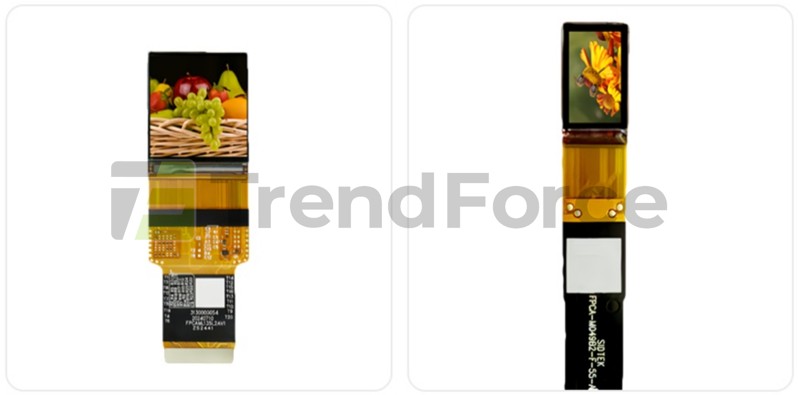
SIDTEK’s 1.35-inch (left) and 0.49-inch (right) OLEDoS microdisplays
As Yu Ningning explained, in the VR/MR market, SIDTEK’s 1.35-inch 4K microdisplays are well-positioned for premium and flagship MR products, while its 1.03-inch 2.5K microdisplays are suitable for lightweight MR products. In the video-centric AR market, SIDTEK provides a comprehensive portfolio encompassing the 0.49FHD entry-level devices and the 0.61WQHD+ flagship models. In the teleprompter AR market, the company currently operates 8-inch production lines for 0.23-inch microdisplays, while also developing new microdisplays for 12-inch production lines. This 12-inch lineup aims to achieve a resolution of 960x640 and a brightness of 12,000 nits, thereby enhancing full-color display performance in AR teleprompter applications.
Expanding 12-Inch Production Lines to Secure its Stronghold as a Front-Runner
International OLEDoS suppliers have increasingly adopted the 12-inch wafer platform in recent years. By increasing wafer size, production efficiency can be improved, while manufacturing costs per unit can be further reduced, thereby meeting growing consumer market demand. For domestic suppliers in China, 12-inch capacity buildup not only signals capacity expansion but also marks the onset of a new technology platform and advanced manufacturing capabilities.
To address increasing customer requirements for OLEDoS microdisplays, SIDTEK has built on its extensive experience with 8-inch production lines, further accelerating the large-scale deployment of 12-inch production lines.
Currently, SIDTEK’s 12-inch production line in Wuhu has successfully ramped up to volume production, achieving a monthly output of 6,000 wafers (based on 12-inch wafers). Meanwhile, its 12-inch production line in Nanchong is under construction, with plans to enter production in 2027 and yield an additional capacity of 6,000 wafers per month.
Strengthening Overall Competitiveness with Consolidated “8+12 inch” Wafer Capacity
SIDTEK has consolidated its “8+12 inch” wafer capacity, thereby unlocking compounding advantages in its strategic planning.
Regarding the technology roadmap and capacity, SIDTEK has leveraged its long track record of extensive expertise and long-term operations in 8-inch wafer production, thereby elevating the benchmark for its 12-inch production lines at their establishment. The company has successfully developed an industry-leading 12-inch production solution, ensuring mass production stability and supply chain resilience across its 12-inch production lines.
Regarding product positioning and marketing, the combination of “8+12” inch wafer capacity has enabled SIDTEK to ensure production agility and diversify its product portfolio. Specifically, its 8-inch production lines provide high efficiency and flexibility for low-volume production and rapid technical validations, while its 12-inch production lines feature centralized mass production capabilities, ensuring large-scale delivery and efficient cost optimization. This “8+12 inch” manufacturing strategy also unlocks the potential of diversified customer demands across various markets, while creating more room for dynamic capacity deployment based on individual customer requirements.
Looking Ahead
Yu Ningning concluded that SIDTEK will continue to enhance its R&D capabilities, targeting breakthroughs in key specifications such as brightness, power consumption, and color gamut. The company has strategically focused on Real RGB technology to significantly increase OLEDoS brightness.
To meet diversified market demands, SIDTEK has transitioned from a “standard product-driven” model to a “dual model of standard and customized solutions.” This strategic shift enables the introduction of more customized solutions for top-tier customers, thereby meeting the diverse development and integration needs of a differentiated customer base.
Looking ahead, AR glasses, MR devices, and other on-device AI hardware are set to create an increasingly diversified market landscape, with product positioning spanning a wide spectrum of specifications and cost structures. Against this backdrop, market players are expected to drive innovation in display technologies and develop new product platforms and manufacturing systems with greater flexibility to secure a stronghold in the next phase of industry development.
TrendForce 2025 Near-Eye Display Market Trend and Technology Analysis
Publication Date : 29 August 2025
Language : Traditional Chinese / English
Format : PDF
Page Number: 168
|
If you would like to know more details , please contact:
|


