Nichia, the world's largest LED/Laser Diode manufacturer and inventor of the high-brightness blue and white LEDs, has established a joint research course in the field of microbial control at the Graduate School of Biomedical Sciences, Tokushima University (Professor Akira Takahashi, Department of Preventive Environment and Nutrition), and has conducted evaluations of ultraviolet-induced inactivation of various microorganisms, including fungi, bacteria, and viruses. Through this joint research, the UV dose required for the inactivation of various microorganisms using 280nm LEDs, the peak wavelength of Nichia's mass-produced UV-C LEDs, was determined. The results are presented below.
Inactivation of microorganisms using UV light has been widely studied with mercury lamps, tunable wavelength lasers, and LEDs. In recent years, UV LEDs have been gaining attention as a solution for infection control equipment, due to the development of various wavelengths and the small form factor providing design flexibility. However, evaluation systems and measurement methods suitable for accurately assessing UV sensitivity with UV LEDs have not yet been fully established. Irradiation conditions vary amongst studies, making it difficult to directly compare and evaluate microbial inactivation performance across different research results. To address these challenges, Nichia recognized the need for a standardized irradiation device and evaluation method and developed a UV LED irradiation device in 2023 based on strictly controlled irradiation conditions.
Since 2023, Nichia and Tokushima University have conducted joint research using this device to evaluate the effectiveness of different UV wavelengths for inactivating various microorganisms, including fungi, bacteria, and viruses. Following the publication of a paper summarizing the research results, Nichia has compiled the UV dose required for the inactivation of various microorganisms using 280nm LEDs, which correspond to the peak wavelength of Nichia's mass-produced UV-C LEDs, while considering not only the inactivation effectiveness but practical considerations such as the LED output and lifetime characteristics. The results for the fungi (6 species), bacteria (11 species), and viruses (12 species) are shown below.
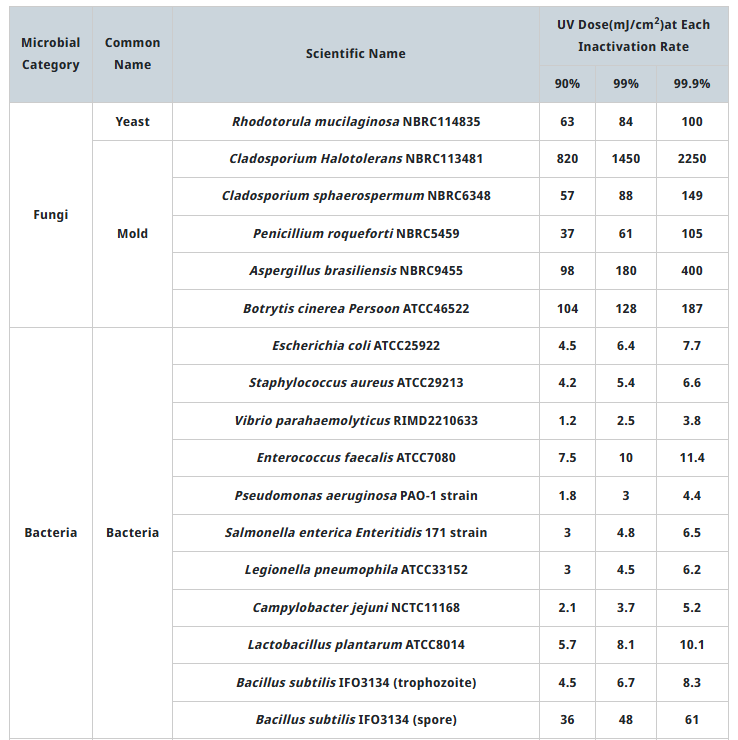
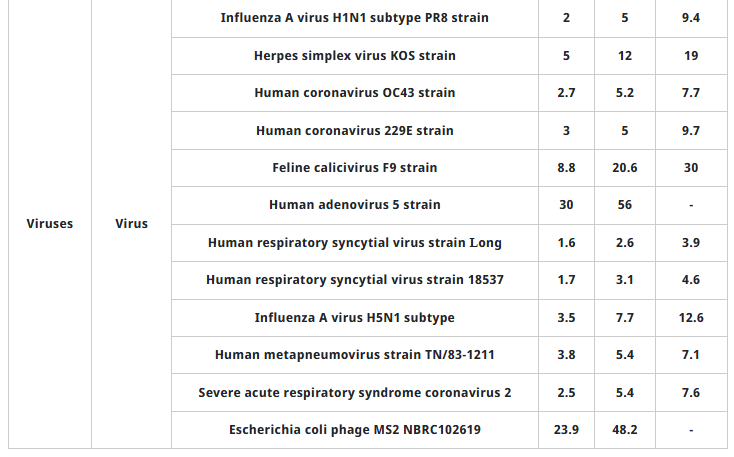
These research findings are expected to help improve the accuracy of UV LED-based microorganism inactivation evaluations and support the establishment of appropriate test conditions. By continuing to utilize this device, Nichia will advance the selection of optimal LEDs, equipment design, and irradiation conditions based on standardized and comparable evaluations across different wavelengths, contributing to the wider practical adoption and commercialization of UV-based technologies.
TrendForce 2026 Deep UV LED Market Trend and Product Analysis
Release: 31 March 2026
Language: Traditional Chinese / English
Format: PDF / EXCEL
Page: 80
If you would like to know more details , please contact:


