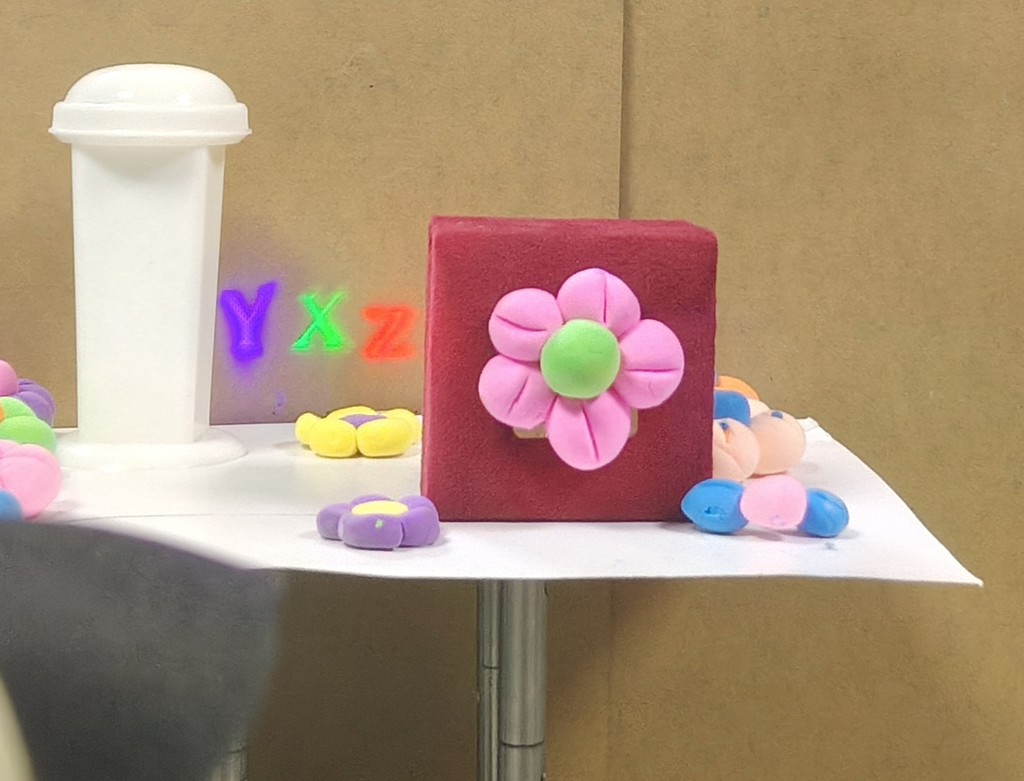
Researchers have developed a full-color near-eye display that uses three stacked holographic gratings, each engineered to direct red, green or blue light. The new design could help advance compact, energy-efficient augmented reality (AR) glasses for use in a variety of professional and consumer applications.
Holographic gratings are microscopic optical structures that use a laser-recorded interference pattern to precisely redirect and shape light. In a near-eye display, they can be used to couple light into and out of a transparent waveguide, allowing digital images to be delivered to the viewer’s eye.
“As augmented reality becomes increasingly integrated into everyday life, there is a growing need for lightweight, energy-efficient and easy-to-manufacture display technologies,” said research team leader Raj Kumar from CSIR- Central Scientific Instruments Organisation and the Academy of Scientific and Innovative Research (AcSIR), both in India. “Our stacked grating design can produce bright images while using less power, which is especially beneficial for enabling lightweight, battery-powered AR glasses that display clear virtual images in bright indoor and outdoor environments.”
In the Optica Publishing Group journal Applied Optics, the researchers report on a lab prototype that incorporates the stacked holographic gratings. The new design is enabled by a prism-free fabrication method that eliminates the need to align multiple gratings, making multilayer holographic light couplers easier to manufacture and reproduce.
“This technology could be useful in see-through displays used in AR glasses for navigation, industrial assistance, education, medical visualization, maintenance, training and other applications where color information must be overlaid on the real world,” said the paper’s first author Sheenam Saxena from CSIR. “It should also be possible to extend the technique to the fabrication of large-sized displays, such as head-up displays (HUDs) for vehicles.”
Stacking layers for brighter images
The near-eye displays used in AR glasses combine a small display with an image combiner that seamlessly integrates digital content with the real-world environment. Holographic waveguides are a promising option as an image combiner because they use holographic gratings to guide digital images to the user's eye while remaining thin and lightweight.
However, conventional fabrication methods used to create holographic gratings rely on bulky prisms, which complicates the manufacturing process. Although full-color holographic waveguides have been demonstrated, the red, green and blue (RGB) gratings were recorded in a single photopolymer film, which reduces diffraction efficiency, resulting in dimmer images.
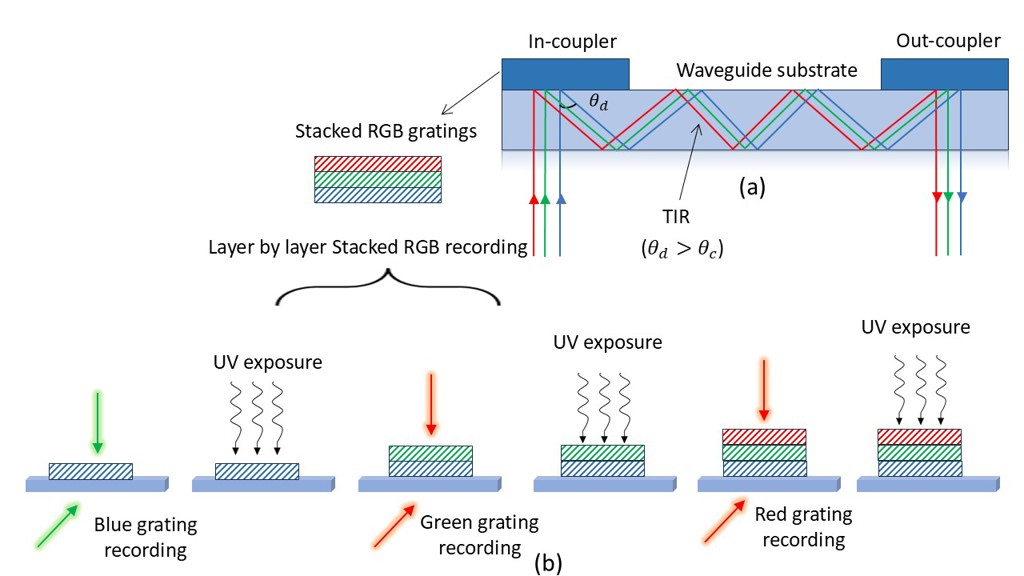
To create a full-color waveguide that produces brighter images, the researchers developed a prism-free multilayer approach that records each color grating separately in a photopolymer film and stacks the layers during the fabrication process. This preserves their relative alignment and eliminates the need for a complex post-recording alignment.
“Our approach uses a simpler and more flexible fabrication process while also allowing each color channel to be optimized independently,” said Kumar. “This improves the overall light efficiency, allowing brighter virtual images to be produced with the same input power, therefore, reducing the power required from the display source.”
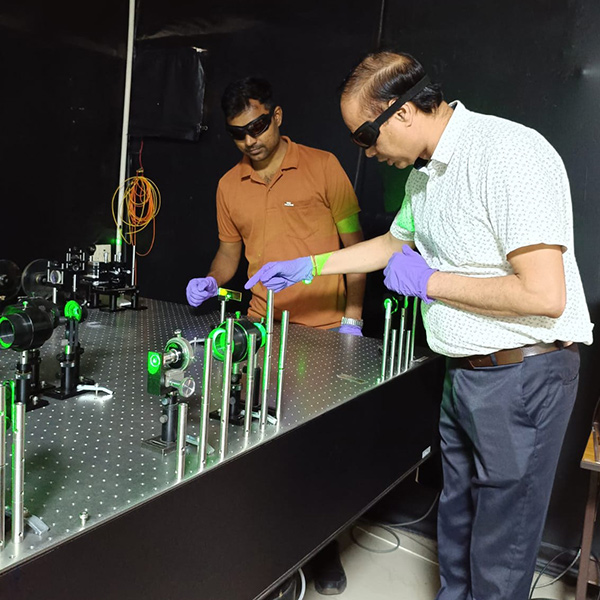
Testing the approach
To demonstrate the technology, the researchers incorporated stacked RGB holographic gratings into a transparent glass waveguide as both an in-coupler and an out-coupler. During operation, light from the display would fall normally onto the in-coupler, which directs it into the glass at a sufficiently high angle, causing it to become trapped and propagate through the waveguide by total internal reflection. When the guided light reaches the output coupler, the light would be guided out of the glass towards the viewer’s eye.
The researchers used a miniature digital display to generate test images, and a collimating lens directed the image light normally onto the in-coupler. The results showed successful propagation of the bright red, green, blue and full-color images, confirming the effectiveness of the prism-free stacked RGB approach.
Next, the researchers plan to improve the performance of the display as a whole, rather than focusing only on the individual holographic couplers. This includes expanding the field of view and improving color uniformity. Before the technology could be commercialized, it would need to be integrated into a compact, eyeglasses-like prototype and evaluated for factors such as brightness, image quality, power consumption, eye comfort and long-term reliability.
Paper: S. Saxena, R. Kaur, R. Kumar, “Self-aligned prism-free fabricated stacked holographic couplers for full color augmented reality display,” Applied Optics, 65, 8075-8081 (2026).
DOI: 10.1364/AO.604532
TrendForce 2025 Near-Eye Display Market Trend and Technology Analysis
Publication Date : 29 August 2025
Language : Traditional Chinese / English
Format : PDF
Page Number: 168
|
If you would like to know more details , please contact:
|


