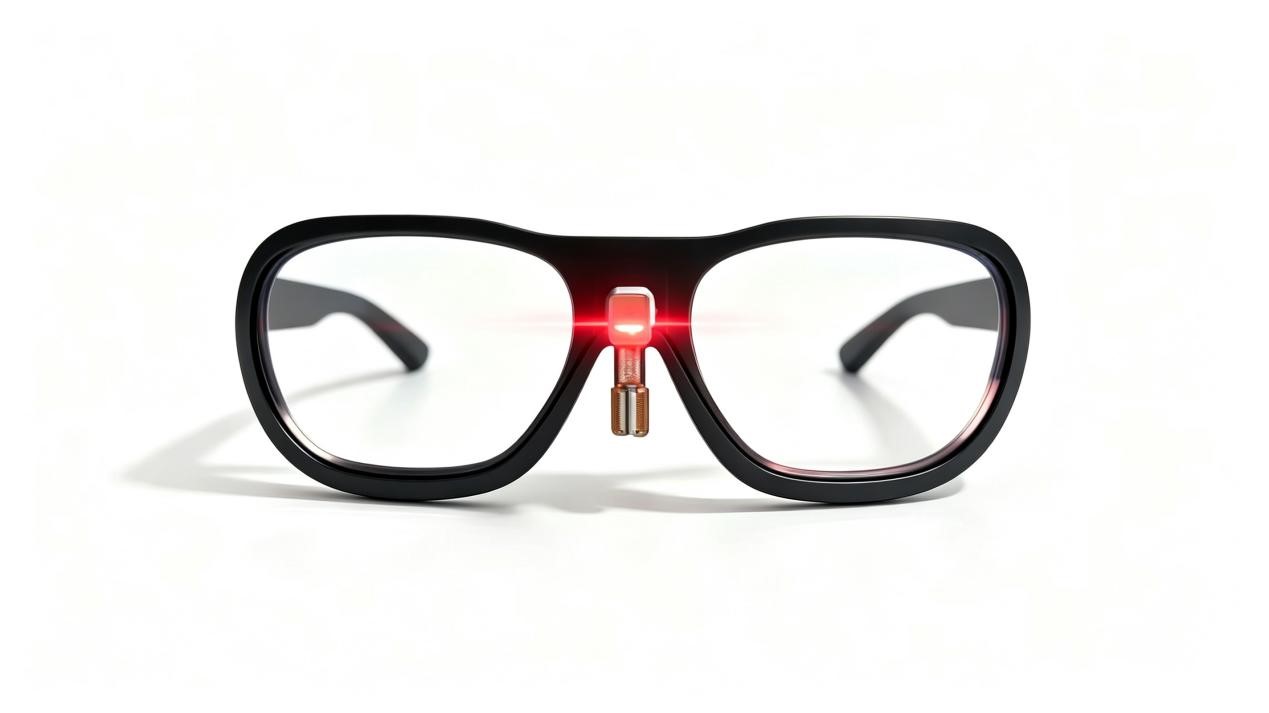
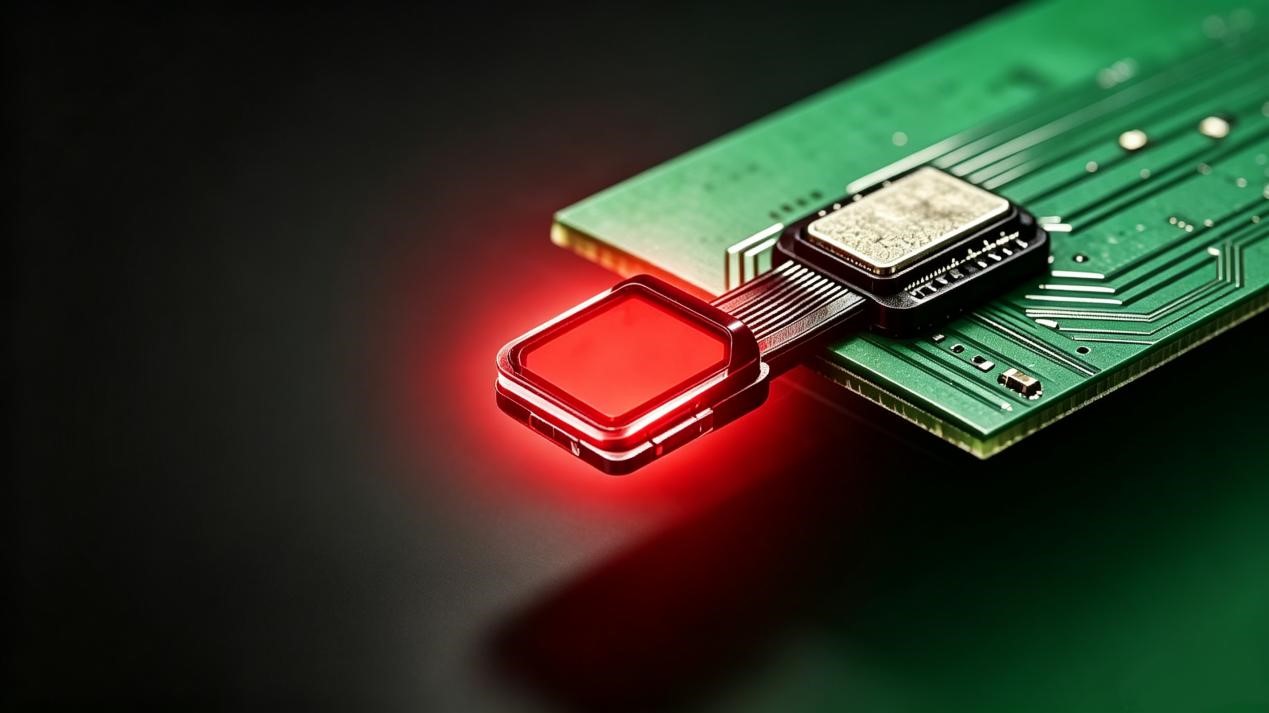
Ningbo Qiushui Semiconductor Technology Co., Ltd. ("QSSEMI") today released the world's first mass-producible 8-inch red Micro-LED chip. Built on the company's industry-first damage-free Micro-LED technology, the product completes the first full process integration of hybrid bonding on an 8-inch quaternary AlInGaP red material system, delivering 640×480 red display in a volume of just 0.15 cubic centimeters. The breakthrough is seen as a landmark in AR glasses' transition from today's mainstream monochrome-green approach to full color — and gives the industry a practical path to volume production that could accelerate full-color AR eyewear.
Built on this chip, QSSEMI also unveiled the 013 red light engine. For the first time, AR glasses makers worldwide have a mass-producible red Micro-LED near-eye light engine to build on — a step toward commercializing full-color AI glasses.
1. About Qiushui Semiconductor
Ningbo Qiushui Semiconductor Technology Co., Ltd., founded in November 2022 and headquartered in Ningbo High-Tech Zone, is a semiconductor company focused on Micro-LED micro display chips and modules‘s manufacturing. It pioneered the "Damage-free" Micro-LED chip technology route: its hybrid-bonding vertical stack architecture abandons conventional physical mesa etching entirely, eliminating emitter-material damage at the source and providing a breakthrough solution for scaled Micro-LED production and full-color integration. Its products serve AR glasses, digital automotive lighting, and micro-projection.
Founder Jiang Zhenyu began working on Micro-LED displays during his doctoral studies at The Pennsylvania State University, recognizing Micro-LED as the next revolutionary display technology as early as the 2013 launch of the first-generation Google Glass. Today QSSEMI fields a cross-disciplinary R&D team of about 30 people; core members previously worked at HiSilicon, YMTC, and Intel, with deep expertise in advanced semiconductor processes, optoelectronic materials and devices, and packaging and testing.
In May 2025, QSSEMI's damage-free Micro-LED chip passed verification. That same year the company launched its "LEYU AR" product series built on its proprietary technology, becoming the second manufacturer in China with mass-production capability for both micro display chips and modules for AR products.
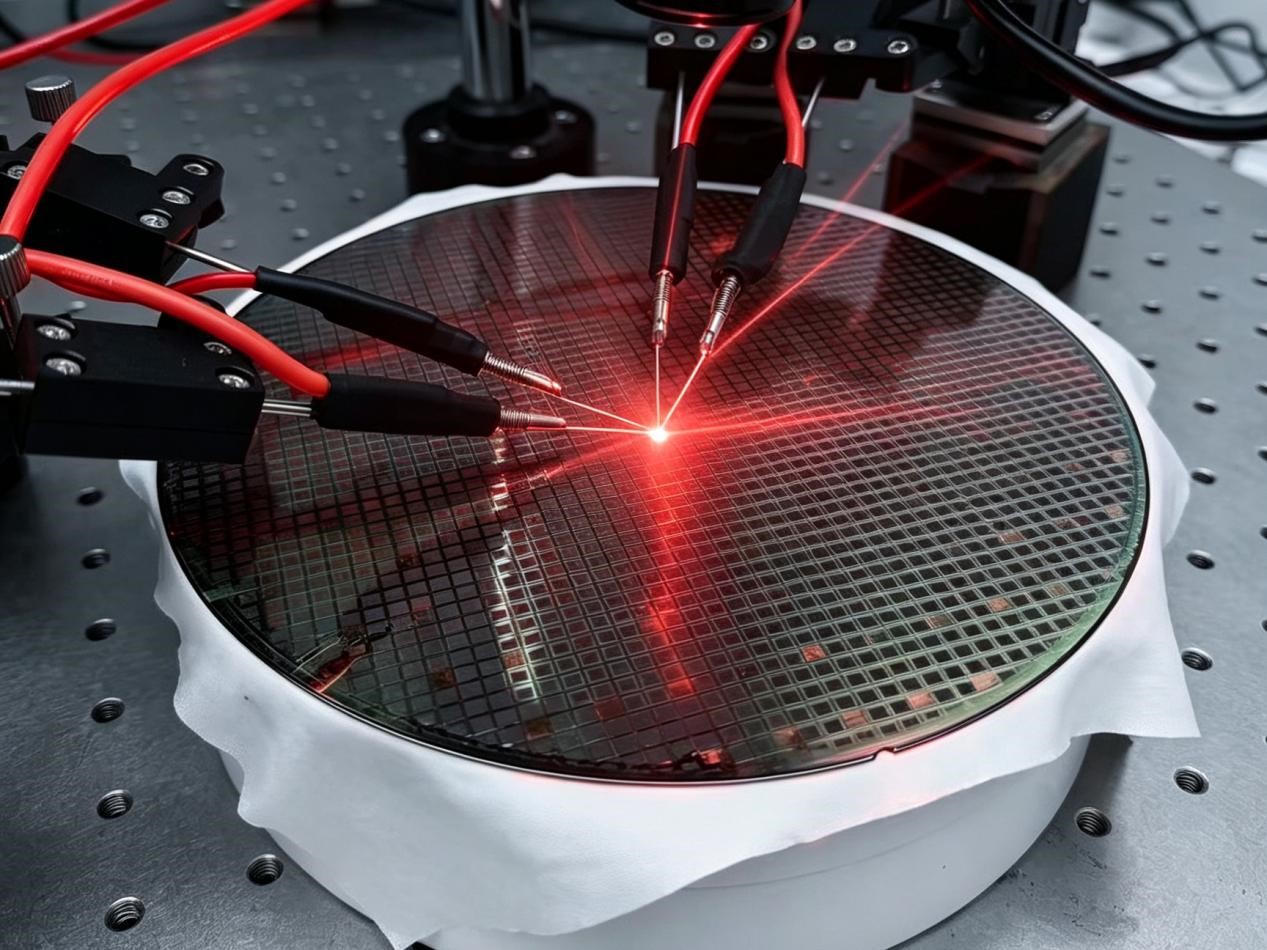
In the first half of 2026, QSEMI closed its Pre-A and Series A rounds , raising nearly RMB 200 million in total. Zhaohui Capital led the financing, with participation by Tongshang Fund, Shengyu Investment, Jiayi Capital,Emerging technology,and the Ningbo Talent Development Fund. Proceeds will mainly fund QSSEMI's 8-inch hybrid-bonding volume-production line in Ningbo, scheduled to go live in October 2026. At full operation it is planned to output 1,000 eight-inch wafers a month — supply capability of more than 10 million Micro-LED chips a year.

2. The industry pain point: red — the "natural barrier" to full-color Micro-LED
Micro-LED is widely regarded as the ultimate display technology for AR glasses, offering high brightness, high contrast, and low power consumption. Yet scaled production of full-color Micro-LED has always stalled at one color: red.
Conventional Micro-LED pixelation uses physical etching to define pixels — like cutting microscopic light-emitting crystals with a crude blade. The process inflicts irreversible etch damage on the emitter material. As pixels shrink, the damaged area claims an ever-larger share of each emitter, degrading luminous efficiency, yield, leakage, and stability. Red AlInGaP is especially sensitive: etching can destroy as much as 97% of its emission efficiency. That is why the industry calls red the "full-color gap" — red Micro-LED wall-plug efficiency has long hovered around 1%.
The industry has tried neutral ion beam etching, reduced etch power, wet chemical removal of the damage layer, and ALD surface passivation. None solved the problem at its root. QSSEMI offers a fundamentally different answer.
3. The breakthrough: from physical isolation to electrical isolation
QSSEMI's core innovation is abandoning physical mesa etching altogether and replacing physical isolation with electrical isolation. In plain terms: conventional approaches dig trenches in the emitter material to separate pixels — damaging it in the process. QSSEMI instead raises an "invisible wall" of electrical insulation between pixels, keeping current flowing vertically and isolating each pixel electrically without disturbing the physical structure.
Making this route work required combining hybrid bonding — a mature process in advanced semiconductor manufacturing — with the Micro-LED production flow. Through its hybrid-bonding vertical stack, QSSEMI has demonstrated fine-pitch interconnection between the photonic die and the driver die at 3.75-micron pixel pitch, with bonding pitch scalable to 2 microns — the same process node as the advanced hybrid-bonding technology in Huawei's recently announced "Tao (τ) Law."
On this industry-first damage-free route, QSSEMI reports key results:
-
Pixel yield raised above 6N (99.9999%);
-
Emission angle narrowed from ±60° in conventional designs to ±10°, effectively curbing pixel crosstalk;
-
Operating temperature range expanded from below 50°C to above 140°C, meeting automotive-grade and consumer-electronics requirements;
-
Red-channel wall-plug efficiency (WPE) expected to exceed 20%.
A 20% red WPE would mark an order-of-magnitude leap in red efficiency from the damage-free route, paving the way for full-color Micro-LED mass production.
4. The 013 red light engine: small, high-resolution, bright
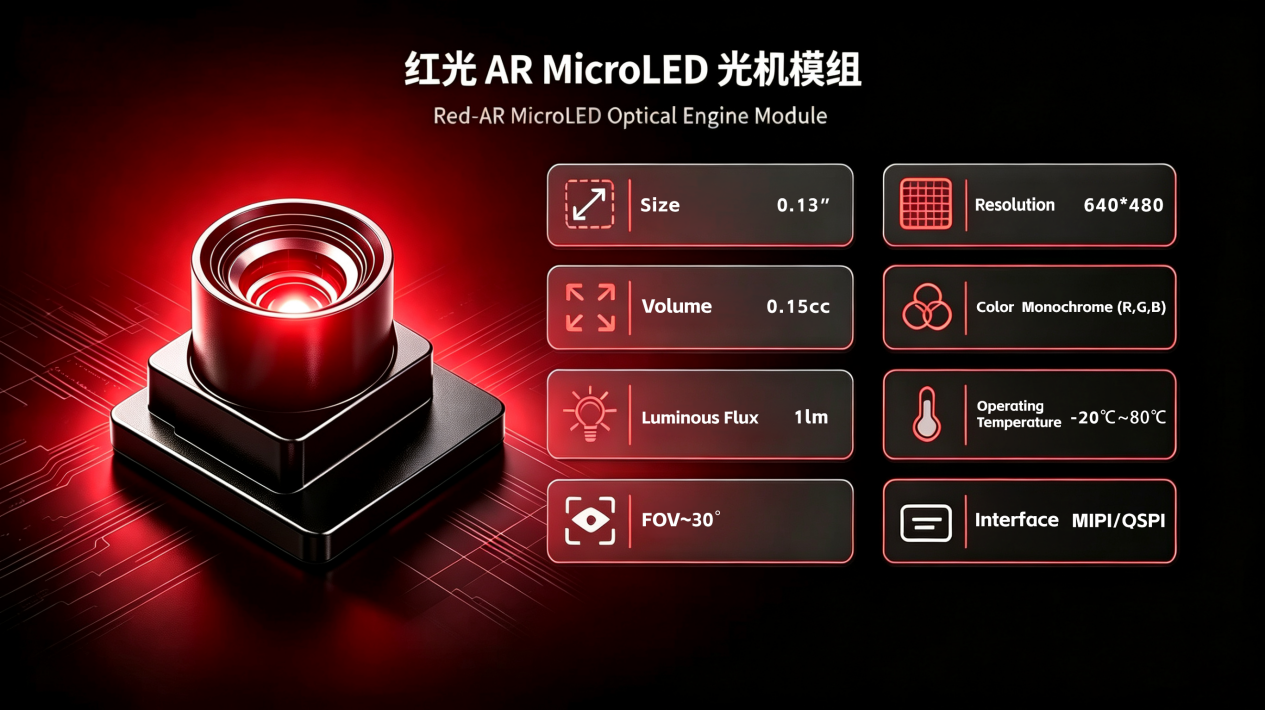
Based on the 8-inch damage-free hybrid-bonding platform, QSSEMI formally launched the 013 red light engine. Key specifications:
-
Resolution: 640×480
-
Volume: 0.15 cm³
-
Field of view: 20–30°
-
Projection distance: theoretically focusable at infinity
-
Backplane: mature driver backplane for high refresh rate and stable operation
The 013 compresses a 640×480 high-resolution image into just 0.15 cubic centimeters, delivering brighter, finer red display across a 20–30° field of view. With mature backplane circuitry and high-refresh-rate driving, it fits the industrial-design requirements of lightweight AR glasses — a solid light source for meeting teleprompters, real-time translation, in-car navigation, and richer full-color AR scenarios to come.
Notably, the damage-free route lets Micro-LED chips ride the fast lane of semiconductor process iterations, moving pixel size quickly from today's mainstream 4 microns toward 2 microns and even sub-micron territory. QSSEMI plans to launch Micro-LED chips below 2 microns — the smallest pixel pitch in the world — enabling higher pixel density and finer display at the same screen area.
5. Outlook: the "iPhone moment" for full-color Micro-LED is coming
Global AI glasses shipments reached 8.7 million units in 2025, up 322% year over year. Yet AR glasses with full-color display remain a tiny share of the market. The industry consensus is that AI glasses need two things at once to reach their "iPhone moment": full color, and volume production.
On volume: QSSEMI's 8-inch hybrid-bonding line goes live in October 2026, targeting 1,000 eight-inch wafers a month — more than 10 million Micro-LED chips a year. With red 8-inch hybrid-bonding process integration complete, the company expects volume shipments of red Micro-LED chips within the year.
On full color: the damage-free route removes the core red-efficiency bottleneck, enabling high-performance red Micro-LED chips built on today's mature AlInGaP materials. Pairing red, green, and blue single-color chips with a three-color light-combining engine opens the door to true mass-market color applications.
And with the 8-inch line's go-live imminent, QSSEMI will accelerate demonstration samples and volume shipments of monolithic full-color damage-free Micro-LED chips using a three-layer hybrid-bonded stack — aiming to pioneer the "iPhone moment" for AI glasses.