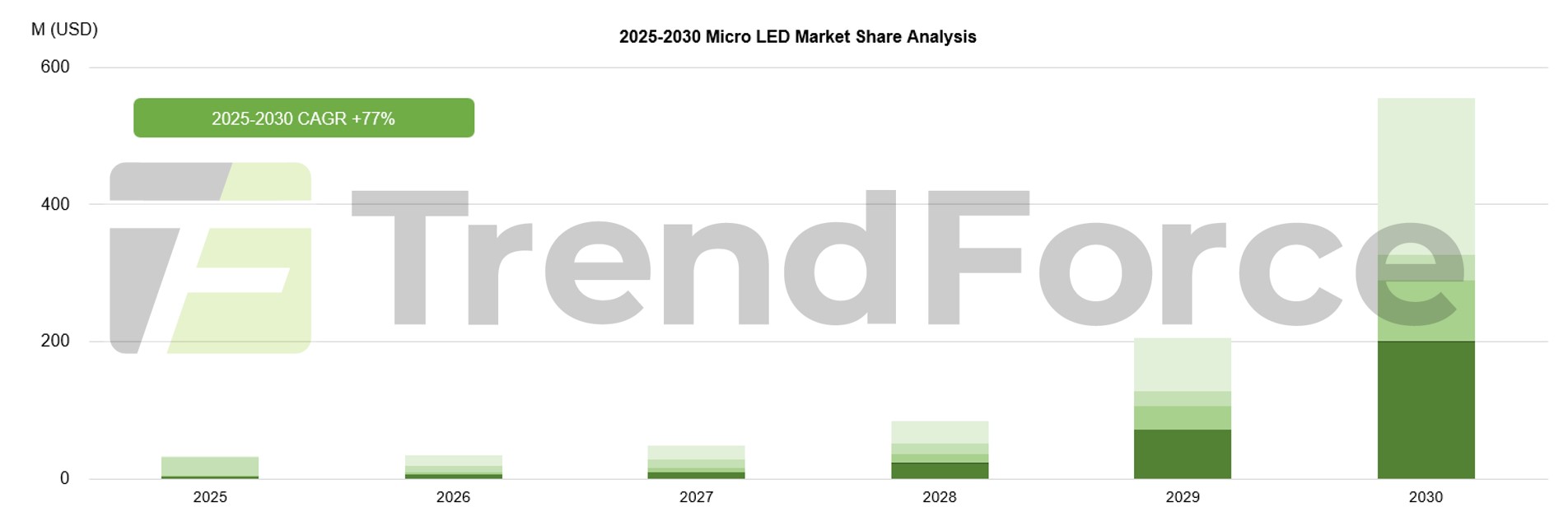
According to TrendForce’s 2026 Micro LED Display and Non-Display Application Market Analysis, due to sluggish consumer market demand and the AI spending crowding-out effect, the Micro LED industry has seen a broad-based shift in business resource allocation toward commercially viable applications. For display applications, barriers to market adoption can be minimized by modular designs and supply chain integration, while future deployment pivots toward interactive and high-value-added sectors. For non-display applications, Micro LED technology is entering the CPO optical interconnect sector to build a stronghold in AI infrastructure. Overall, Micro LED technology has moved beyond the paradigm of conventional single-purpose display technologies, further advancing toward cross-domain applications in smart wearables, smart cockpits, AR, and AI computing infrastructure. This expansion is achieved through incremental market penetration, driving momentum for market growth. By 2030, Micro LED display modules and Micro LED CPO modules are expected to generate a total market value of USD 5.308 billion.
AR Head-Mounted Displays
Driven by the rapid growth in the AI glasses market, Micro LED technology has achieved early breakthroughs in monochrome information displays for AR glasses by leveraging its high brightness, miniaturization, and a compact form factor. Meanwhile, Tier-2 supply chain players are accelerating their market entry, while some manufacturers are committed to full-color Micro LED development. As brands, such as Meta and Google, map out their strategies for high-end AR devices, 2028 is poised to be a turning point for the Micro LED AR market to experience a surge in market volume. Meanwhile, to meet the requirements of brand customers, Micro LEDs are also expected to achieve pixel pitches below 4μm and a resolution exceeding 5,000 PPI, alongside ultra-high brightness levels in the millions of nits. These achievements will enable outdoor information display applications, such as object recognition, real-time navigation, and transcription and translation, further enhancing the technological value of Micro LEDs in all-day wearable AI glasses.
Micro LED Optical Interconnects
The rapid growth in generative AI and AI inference has elevated demand for high-speed connectivity within data centers. Micro LED technology features low power consumption, high transmission density, and low bit error rates, emerging as a promising solution for 800Gbps and 1.6Tbps short-reach optical interconnects. As industry players accelerate market deployment, the Micro LED optical interconnect ecosystem is expected to progressively enter commercial mass production as early as 2H28. Looking ahead, Micro LED technology stands poised to become an emerging light source technology within AI high-performance computing infrastructure, provided that manufacturing costs and processes can be further improved through established semiconductor and display supply chains. This segment will also open up a second growth curve for Micro LEDs beyond the display market.
Wearable Displays
The launch of the Garmin Fenix 8 Pro marks the onset of Micro LED deployment in the high-value-added wearable market, further incentivizing BOE and SDC to develop wearable display panels. With an increasingly mature supply chain and improved power consumption enabled by technologies such as high-voltage chips, Micro LED technology is set to integrate physiological sensing, outdoor navigation, and other features, making it well-positioned as a critical hardware interface for cross-device communication between AI agents. Wearables are also set to evolve from single-purpose information display devices into critical hardware interfaces within the broader real-time AI interactive ecosystem.
Large-Sized and Automotive Displays
Large-sized Micro LED displays are shifting their positioning from high-end TVs toward transparent displays, while reducing chip usage and manufacturing costs by increasing pixel pitch. With high transparency and superior brightness, transparent Micro LED technology is likely to integrate closely with AI spatial computing. This evolution will allow Micro LED displays to move beyond exhibition and commercial applications, further enabling smart retail, interactive window displays, and other applications that serve as critical data carriers for the integration of AI visual recognition and virtual-physical information. Meanwhile, the automotive sector has further reduced Micro LED development costs and adoption risks through standardization of panel sizes and pixel pitches, modular tiling, and supply chain integration. With wider NEV adoption and advances in L3+ autonomous driving technology, Micro LED technology is poised to establish a high-ground edge in transparent automotive window displays, heads-up displays (HUDs), and innovative center console displays. These emerging applications are projected to drive Micro LED deployment beyond in-vehicle displays toward human-vehicle interaction interfaces within AI-powered smart cockpits.
Author: Emerson / TrendForce
TrendForce 2026 Micro LED Display and Non-Display Application Market Analysis
Release: 15 September 2026
Format: PDF
Language: Traditional Chinese / English
Chapter 1. Micro LED Market Share Analysis
-
2026-2030 Micro LED Market Share Analysis
-
2026-2030 Micro LED Market Share Analysis – Head-Mounted Display
-
2026-2030 Micro LED Market Share Analysis – Micro LED CPO
-
2026-2030 Micro LED Market Share Analysis – Wearable Display
-
2026-2030 Micro LED Market Share Analysis – Large-sized Display
-
2026-2030 Micro LED Market Share Analysis – Automotive Display
-
2026-2030 Micro LED Chip Market Share Analysis
-
2026-2030 Micro LED Wafer Market Demand Analysis
-
2026-2030 Micro LED Display Module Market Value Analysis
-
2026 Micro LED Player Capacity Analysis
-
Micro LED Industry - Capital Investment, M&A Alliance & Joint Venture, and Supply Chain Cooperation
Chapter 2. Micro LED Display Applications Market Analysis
2.1 Wearable Display
-
Garmin 1.39-inch Micro LED Watch Display Cost Analysis
-
Micro LED Watch Comparative Analysis
-
Analysis of Micro LED Prototype Watches
-
Garmin Micro LED Watch Manufacturing Analysis
-
SAMSUNG Display Micro LED Watch Manufacturing Analysis
-
Micro LED Watch Business Strategies
-
Tandem Micro LED Emerges as a Key Technology for Power Consumption Reduction
2.2 Large-sized Display
-
Micro LED Chip Shipment Rate and Brand Target
-
2021-2030 Micro LED COC Price Trend
-
Micro LED Mass Transfer Technology Analysis and Trend
-
Side Wiring LTPS Manufacturing Analysis – Samsung, LG
-
Side Wiring LTPS Manufacturing Analysis – BOE, Tianma, Vistar
-
LTPS Player Technology Progress
-
TGV Glass Pros and Cons Analysis
-
Micro LED TV Manufacturing Analysis – LG
-
Micro LED TV Manufacturing Analysis – Tianma
-
Micro LED Transparent Display Manufacturing Analysis – AUO
-
Micro LED(COG)TV Progress – Samsung, LG, Vistar
-
Micro / Mini LED(COG)TV Progress – BOE, Tianma, Ledman
-
Micro LED TV / Video Wall Player’s Supply Chain Analysis
-
136 / 163-inch Micro LED TV Cost Analysis
-
Micro LED Transparent Display Application Scenarios
-
Panel Makers' Large-Sized Display Strategies
-
Display Strategies of Chinese Panel Makers
-
AUO Business Strategy
-
Micro LED Dual Transparent Display Development
-
2026 Micro LED Transparent Display Cost Analysis
-
Micraft System Plus
-
Rapitech / Instrument Systems
2.3 Automotive Display
-
Smart Cockpit – From Today to the Future
-
Automotive Display Technology Overview
-
Micro LED Automotive Display Product Overview
-
Panel Makers' Automotive HUD Display Strategies – BOE & Tianma
-
Panel Makers' Automotive Display Strategies
-
2026 Micro LED Automotive Transparent Display Cost Analysis
-
BOE
Chapter 3 Micro LED Head-Mounted Displays Applications Market Analysis
-
2026-2030 Micro LED AR Glasses Shipment Forecast
-
AR Glasses Development
-
Micro LED AR Product Specifications and Supply Chain Analysis
-
2026 Analysis of Light Source Specifications and Pricing Sweet Spot
-
for Near-Eye Displays
-
Micro LED Light Engine
-
Micro LED Light Engine Price and Cost Analysis(1H26)
-
Micro LED Capacity Analysis – Non-Shared MOCVD
-
Micro LED Capacity Analysis – Color-Shared MOCVD
-
12-inch CMOS Development
-
JBD's Conventional Bonding Process
-
Technical Challenges from CMOS Backplane Design to System Integration
-
Process and Cost Challenges of 12-Inch CMOS Scaling to Smaller Nodes
-
Bonding : Size Mismatch Problem
-
Bonding Reconstruction Process
-
Bonding Strategy Choices of Micro LED Manufacturers
-
Comparative Analysis of Bonding Strategies
-
JBD
-
Bonding Reconstitution : MICLEDI / SONY
-
Quantum Confined Stark Effect(QCSE)
-
Porous Technology and Structural Optimization
-
Aledia
-
Porotech
-
Saphlux
-
AR Glasses Roadmap
-
Google Android XR platform
-
Big-Tech Micro LED Supply Chain Analysis
-
AR / VR Industry – Capital Investment, M&A Alliance & Joint Venture, and Supply Chain Cooperation
-
Hongshi Intelligent
-
PlayNitride
Chapter 4. Micro LED Optical Interconnect Application Market and Manufacturer Dynamics
-
2026 Optical Communication Market Trend
-
Optical Communication Applications and Product Definitions
-
Scale-Up Market Requirements
-
2026-2030 Transceiver vs. Micro LED CPO Transceiver Market Scale
-
Power Consumption- SiPh CPO / VCSEL NPO / Micro LED CPO
-
Trend of IC Substrate
-
Micro LED / VCSEL / CW-DFB LD / EML Analysis
-
Micro LED CPO Technology Analysis
-
Fiber
-
ams OSRAM / MediaTek
-
Avicena / Ennostar
-
AUO / Ennostar / Tyntek / Innolux / PlayNitride
-
Toray / Tera Electronics
-
Beneq
-
Micro LED CPO Specification and Supply Chain Analysis
-
Micro LED CPO Alliance and Supply Chain Analysis
-
VCSEL NPO Specification Analysis
-
Micro LED CPO / VCSEL NPO Market Opportunities and Challenges
|
If you would like to know more details , please contact:
|


