On March 2, 2026, the world’s first industry group standard for photoluminescent quantum dot Mini/MicroLED displays—Technical Specification for Photoluminescent Quantum Dot Mini/Micro LED Display Terminals (T/SUCA 053-2026)—was officially released and will take effect on March 12, 2026.
The standard was proposed and administered by the Shenzhen 8K UHD Video Industry Cooperation Alliance. Drafting organizations include Leyard Optoelectronic Co., Ltd., Xi'an SaiFuLeSi Semiconductor Technology Co., Ltd. (Saphlux) , CESI (Shenzhen) Electronic Information Product Standardization Engineering Center Co., Ltd., Xi'an NovaStar Tech Co., Ltd., BOE Technology Group Co., Ltd., and Colorlight Cloud Tech Ltd..
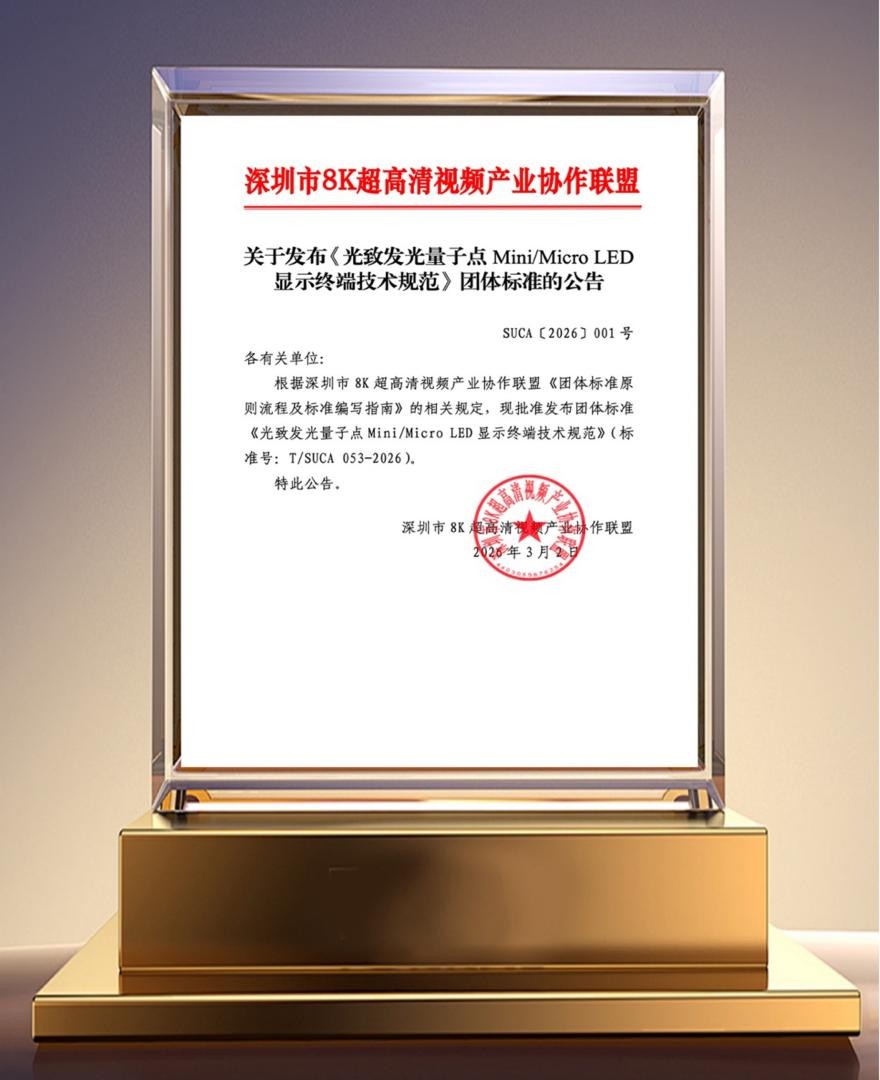
This standard fills a global gap in technical specifications for the in-situ integration of photoluminescent quantum dots with Mini/MicroLED displays. Developed in accordance with GB/T 1.1 2020, it establishes unified definitions, technical requirements, testing and inspection methods, and application boundaries for such products. The standard addresses long-standing industry challenges caused by inconsistent technical benchmarks and uneven product quality.
During the drafting process, Saphlux contributed its globally pioneering NPQD® (Nano-Porous Quantum Dot) technology and incorporated its original in-situ integration approach—along with key performance data on image quality, color performance, and reliability—into the core technical provisions of the standard. Through collaborative efforts, the drafting organizations established key performance metrics for this category of displays, including:
Color gamut coverage ≥85% (BT.2020),
Color accuracy ΔE ≤ 1.5,
and Photoluminescence degradation rate ≤5%.
The standard also defines environmental adaptability requirements, such as performance under high- and low-temperature conditions.
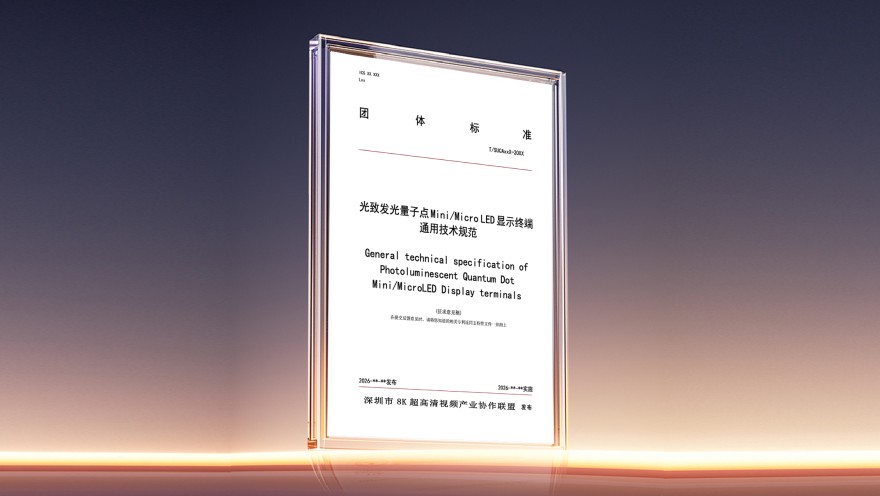
Prior to this release, the integrated display segment lacked a unified standard, which had constrained broader industry development. The introduction of this specification provides a globally consistent technical framework and helps standardize market practices. It is expected to accelerate large-scale adoption of the technology in high-end applications such as commercial displays, XR devices, and virtual production, while further advancing the global display industry.
Looking ahead, Saphlux will continue working with industry partners to advance core technology development and actively participate in both domestic and international standards initiatives. By combining technological innovation with standardized frameworks, the company aims to help build a new industry ecosystem and drive the next generation of global display technologies.


