What Is WICOP Technology?
The Evolution of WICOP 1, 2 and 3 by Seoul Semiconductor
From Package-Free Opto-Semiconductors to High-Voltage Operation and Rare-Earth-Free White Light
WICOP (Wafer Integrated Chip on PCB) is a package-free opto-semiconductor technology developed by Seoul Semiconductor and Seoul Viosys. By eliminating conventional LED packaging structures, WICOP enables smaller chip designs and greater flexibility in opto-semiconductor applications, including Micro LEDs.
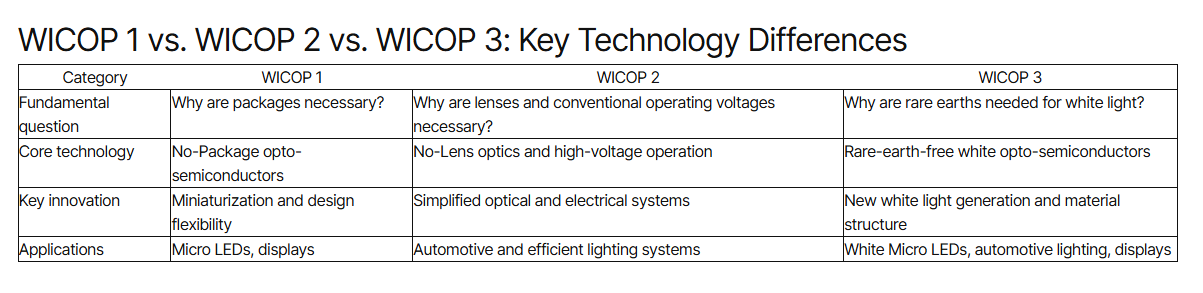
The technology has evolved through three generations: WICOP 1 introduced package-free opto-semiconductors; WICOP 2 expanded the technology into lens-free optical design and high-voltage operation; and WICOP 3 introduced white light generation without rare-earth-based phosphors.
This evolution began with a series of fundamental questions raised by Chung Hoon Lee, founder of Seoul Semiconductor, about the conventional design and operating principles of opto-semiconductors.
Why Was WICOP Technology Developed?
During the 2010s, the global LED industry experienced increasingly intense price competition as numerous manufacturers entered the market.
More than ten major Korean companies and hundreds of Chinese companies participated in the LED industry, accelerating competition in manufacturing costs, production capacity, and technology.
Chung Hoon Lee believed that sustainable growth required more than price competitiveness. It required fundamentally differentiated technologies capable of overcoming conventional limitations.
With a background in physics, Lee remained committed to technological invention and continued investing approximately $100 million annually in research and development, even during challenging business conditions.
This long-term commitment led to three generations of WICOP innovation.
WICOP 1: No-Package Opto-Semiconductor Technology
"Why do semiconductors need packages?"
For decades, semiconductor packaging has played an essential role in protecting chips from moisture, contamination, and other environmental factors while providing electrical connections and mechanical stability.
However, conventional packaging can also increase device size and impose limitations on product design.
Chung Hoon Lee challenged this long-established approach.
After years of research and development, Seoul Semiconductor successfully developed and began mass production of its package-free WICOP technology in 2018.
By eliminating conventional packaging structures, WICOP enabled further miniaturization and design flexibility, establishing an important technological foundation for Micro LED development.
Building on WICOP technology, Seoul Semiconductor and Seoul Viosys have advanced Micro LEDs smaller than 100 micrometers (μm).
The companies have also pursued long-term collaborative research with the University of California, Santa Barbara (UCSB), achieving development milestones at the 1 μm scale.
The key innovation of WICOP 1 was the elimination of conventional packaging requirements, opening new possibilities for smaller opto-semiconductor devices and emerging applications.
WICOP 2: No-Lens Optical Design and High-Voltage Opto-Semiconductors
"Why do LEDs need lenses to control light direction?"
"Why must LED chips operate at approximately 3 volts?"
The second generation of WICOP emerged from fundamental questions about optical control and operating voltage.
Conventional LED lighting systems often use additional optical lenses to control light distribution and direction. A typical single LED chip operates at approximately 3V, requiring series connections or additional circuitry for higher-voltage applications.
Seoul Semiconductor challenged these design conventions by developing lens-free light distribution technology and high-voltage opto-semiconductor solutions operating at 12V or 24V.
These technologies can simplify optical and electrical system design, reduce the need for additional components, and improve overall system efficiency.
In automotive applications, particularly electric vehicles (EVs) and hybrid electric vehicles (HEVs), high-voltage opto-semiconductors can help reduce component requirements and improve power efficiency.
Seoul Semiconductor supplies related WICOP technologies to global automotive companies, including Tesla.
WICOP 2 expanded the scope of innovation beyond chip miniaturization to optical performance, electrical design, and system-level efficiency.
WICOP 3: Rare-Earth-Free White Opto-Semiconductor Technology
"Why do we need rare earths to produce white light?"
The third generation of WICOP began by questioning the conventional method of generating white light.
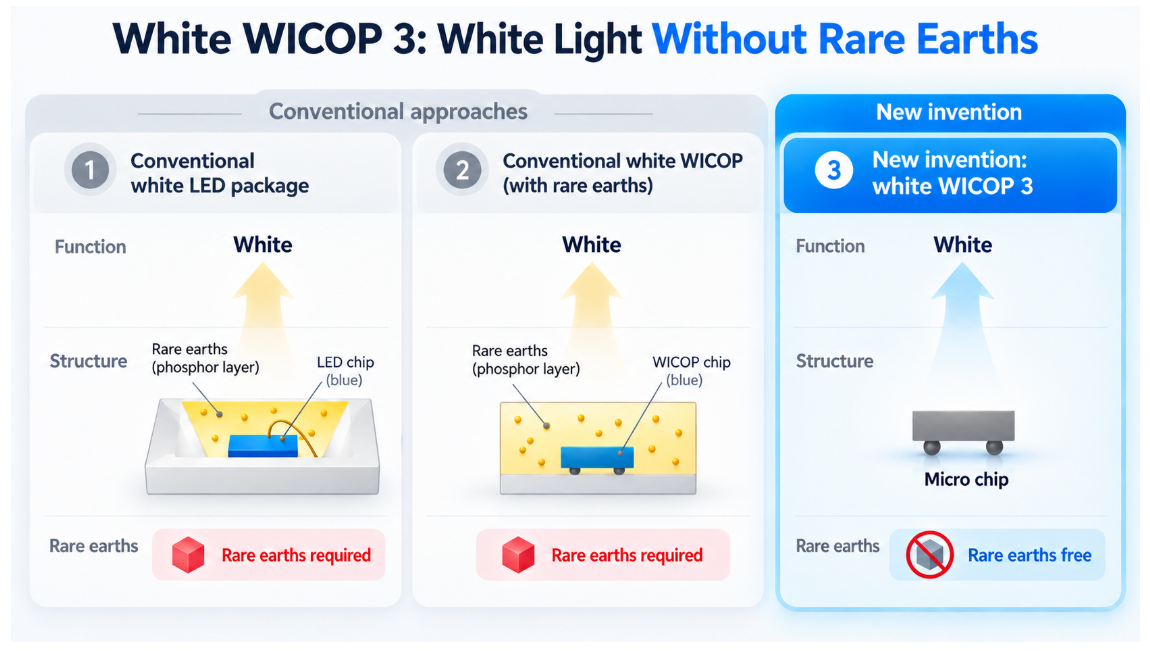
For more than three decades, a widely used approach to producing white LEDs has involved combining blue LED chips with phosphors that convert part of the emitted light into longer wavelengths.
One of the most common phosphor materials is YAG (Yttrium Aluminum Garnet), which contains yttrium, a rare-earth element.
However, the global rare-earth supply chain is geographically concentrated, making it vulnerable to supply disruptions, price fluctuations, and geopolitical risks.
To address the limitations of conventional white LED technology, Seoul Semiconductor and Seoul Viosys developed WICOP 3, a new generation of white opto-semiconductors that generate white light without rare-earth-based phosphors.
The companies have announced the development of the technology and the start of mass production.
WICOP 3 combines no-package opto-semiconductor technology with a new approach to generating white light without rare-earth-based phosphors.
This innovation presents a technological alternative to conventional phosphor-based white LEDs while creating opportunities for further miniaturization and more flexible device designs.
WICOP 3 also expands the potential for white Micro LEDs smaller than 100 μm, supporting future applications in automotive lighting, displays, miniature lighting systems, and other emerging opto-semiconductor technologies.
Frequently Asked Questions About WICOP Technology
Q1. What is WICOP technology?
WICOP (Wafer Integrated Chip on PCB) is a package-free opto-semiconductor technology developed by Seoul Semiconductor and Seoul Viosys. It eliminates conventional LED packaging structures to enable smaller devices and greater design flexibility.
Q2. What is the difference between WICOP 1 and WICOP 2?
WICOP 1 focuses on eliminating conventional semiconductor packaging. WICOP 2 extends the technology to lens-free optical design and 12V or 24V high-voltage operation, enabling improvements in optical and electrical system design.
Q3. How is WICOP 3 different from conventional white LEDs?
Conventional white LEDs commonly combine blue LED chips with phosphors containing rare-earth elements, such as yttrium-based YAG. WICOP 3 generates white light without rare-earth-based phosphors, offering a different approach to white opto-semiconductor technology.
Q4. Why is rare-earth-free white LED technology important?
Rare-earth-free white LED technology can reduce dependence on rare-earth-based phosphor materials and potentially mitigate related supply chain risks. It also creates opportunities for new white light generation structures and miniaturized opto-semiconductor applications.
Q5. Where can WICOP technology be used?
WICOP technology can be applied to Micro LEDs, automotive lighting, displays, and other opto-semiconductor applications. Its package-free architecture and miniaturization capabilities are especially relevant to applications requiring compact devices and flexible optical designs.
Redefining the Future of Opto-Semiconductors
The evolution of WICOP technology began with three fundamental questions:
Why do semiconductors need packages?
Why must optical and electrical designs follow conventional approaches?
Why should white light depend on rare-earth materials?
By questioning these long-established conventions, Seoul Semiconductor and Seoul Viosys have advanced WICOP technology across three generations, transforming semiconductor packaging, optical and electrical design, and white light generation.
Through continued research and development, the companies aim to expand the capabilities of opto-semiconductors and create new opportunities across industries.
(Photo credit: Seoul Semiconductor)


