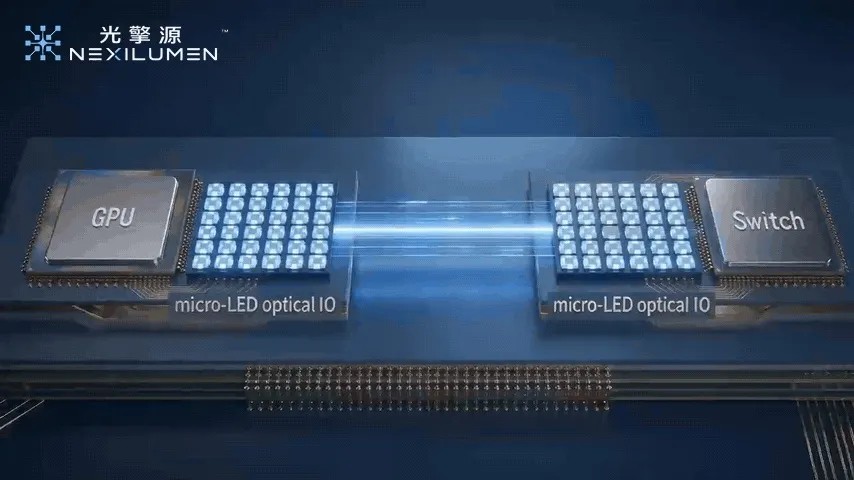
Nexilumen, a spin-off from Fudan University, has made new progress in Micro LED optical interconnects, increasing aggregate bandwidth through space-division multiplexing (SDM) and wavelength-division multiplexing (WDM). Its 16-channel Micro LED array achieved a data rate of 37 Gbps, while a five-channel WDM solution reached a data-rate density of approximately 201 Gbps/mm².
In SDM, Nexilumen uses a 4 × 4 green Micro LED array integrating 16 independently driven pixels. Each pixel delivers an average data rate of approximately 2.3 Gbps, with all 16 channels operating simultaneously to achieve an aggregate data rate of 37 Gbps. The company said its team is developing communication systems with hundreds of channels.
For WDM, Nexilumen integrated violet, blue, and green InGaN Micro LEDs alongside yellow and red hybrid Micro LED/quantum-dot pixels on a single silicon substrate. The 320 × 290μm area accommodates five independently driven wavelength channels. By transmitting independent signals at different wavelengths through the same optical path, the system achieved a data rate of 18.66 Gbps across five channels, corresponding to a data-rate density of approximately 201 Gbps/mm² based on the total emitter-chip area.
In separate research previously published in Nature Communications, Nexilumen demonstrated a transmitter energy efficiency of 0.056 pJ/bit at a communication rate of 1.5 Gbps through communication-link and algorithm optimization.
At CIOE 2026, Nexilumen also showcased advances in long-wavelength InGaN Micro LEDs, 405 nm high-speed light sources, and multichannel parallel optical links. Its long-wavelength devices achieved an electro-optical modulation bandwidth of 2.85 GHz at a current density of 6.25 A/cm², while its 405 nm light source maintained a modulation bandwidth above 3 GHz across the full operating current range.
Nexilumen builds on joint research by Professor Tian Pengfei’s team at Fudan University and Professor Shen Bo’s team at Peking University. Previous demonstrations by the teams achieved communication rates exceeding 10 Gbps for a single blue Micro LED and 9 Gbps for a green device, alongside multichannel system validation at 20 Gbps across two channels and 37 Gbps across 16 channels.
In July 2026, Nexilumen announced the completion of a seed funding round worth tens of millions of yuan, jointly backed by Fudan Innovation and Furuong Investment.
The company is now working to translate laboratory research into engineering applications, focusing on Micro LED light sources, drivers, and system solutions for short-reach interconnects, including co-packaged optics (CPO) and chip-to-chip optical I/O. It also plans to develop and validate a prototype optical interconnect system targeting 1.6 Tbps.
(Photo credit: Nexilumen)
TrendForce 2027 Infrared Sensing and Optical Communication Market Trend
1. Annual Report
Release: 01 January 2027
Format: PDF / EXCEL
Language: Traditional Chinese / English
2. Optical Communications- InP Laser Diode & InGaAs Photodiode Quarterly Price Report
a. InP Substrate- 3-inch
b. EML- 100 / 200G
c. CW-DFB LD- 50 / 70 / 100mW
d. InGaAs Photodiode- 100 / 200G
e. DSP- 800G / 1.6T
Release: 20th of February, May, August, and November, 2027
Format: EXCEL
Language: Traditional Chinese / English
TrendForce 2026 Micro LED Display and Non-Display Application Market Analysis
Release: 15 September 2026
Format: PDF
Language: Traditional Chinese / English
|
If you would like to know more details , please contact:
|


