Samsung Electronics and POSTECH have published a research paper titled “Switchable 2D-3D display through a metasurface lenticular lens” in the prestigious journal Nature, marking notable progress in next-generation display technology through industry-academia collaboration.
Rethinking 3D Displays With Metasurfaces
A metasurface lenticular lens-based switchable 2D/3D display uses an ultra-thin metalens1 composed of nanoscale structures to transition seamlessly between flat (2D) and stereoscopic (3D) images.
A metasurface is significantly thinner while enabling complex optical functions — making it key to next-generation displays and camera systems.
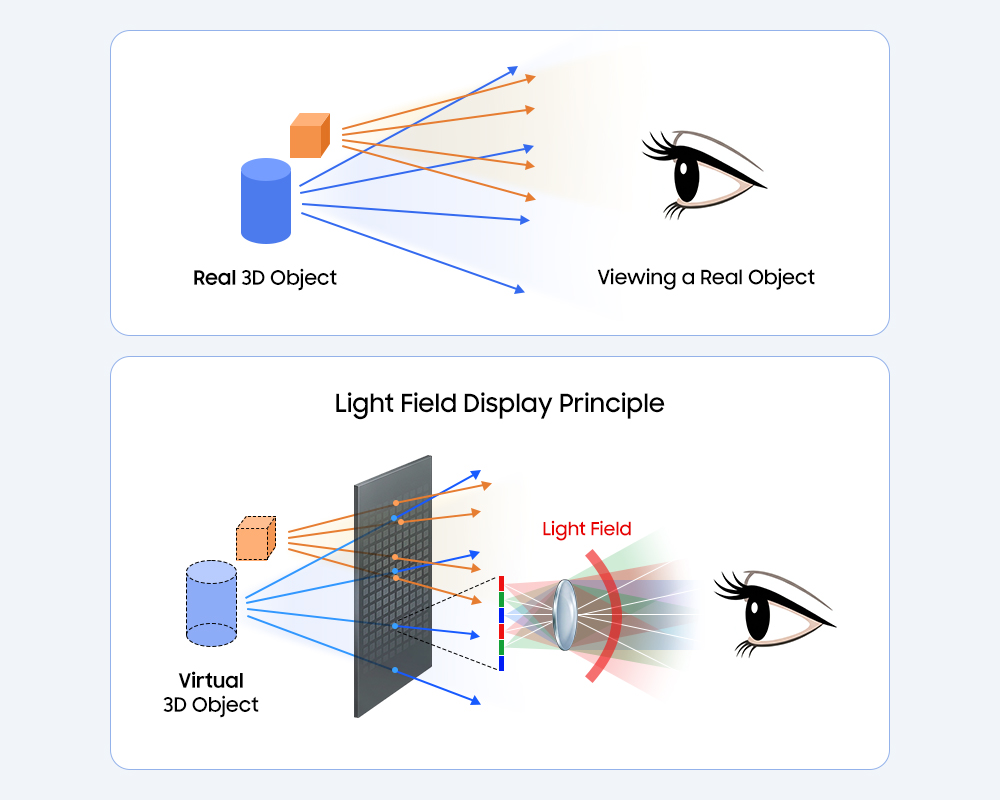
A Light Field Display presents different images depending on the viewing angle
This approach advances Light Field Display by directing light from multiple angles to create a glasses-free 3D experience that mimics real-world perception.
Though long considered promising for entertainment, augmented reality (AR) and medical imaging, conventional Light Field Displays face commercialization challenges, including bulky optics, narrow viewing angles (around 15 degrees), reduced resolution and reliance on real-time eye tracking.
The research team addressed these limitations using polarization — the direction in which light oscillates — to design a metasurface lenticular lens (MLL) that dynamically adjusts focal properties.
Switching Between 2D and 3D
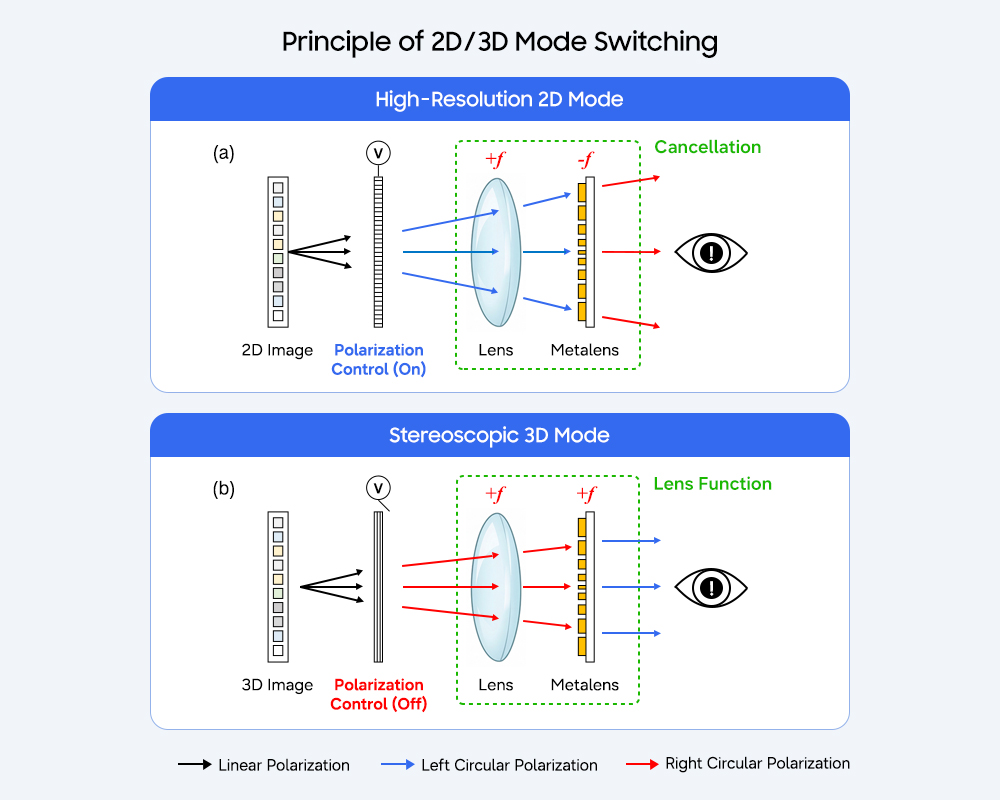
Diagram showing how the metalens switches between high-resolution 2D and stereoscopic 3D modes based on the polarization controller state
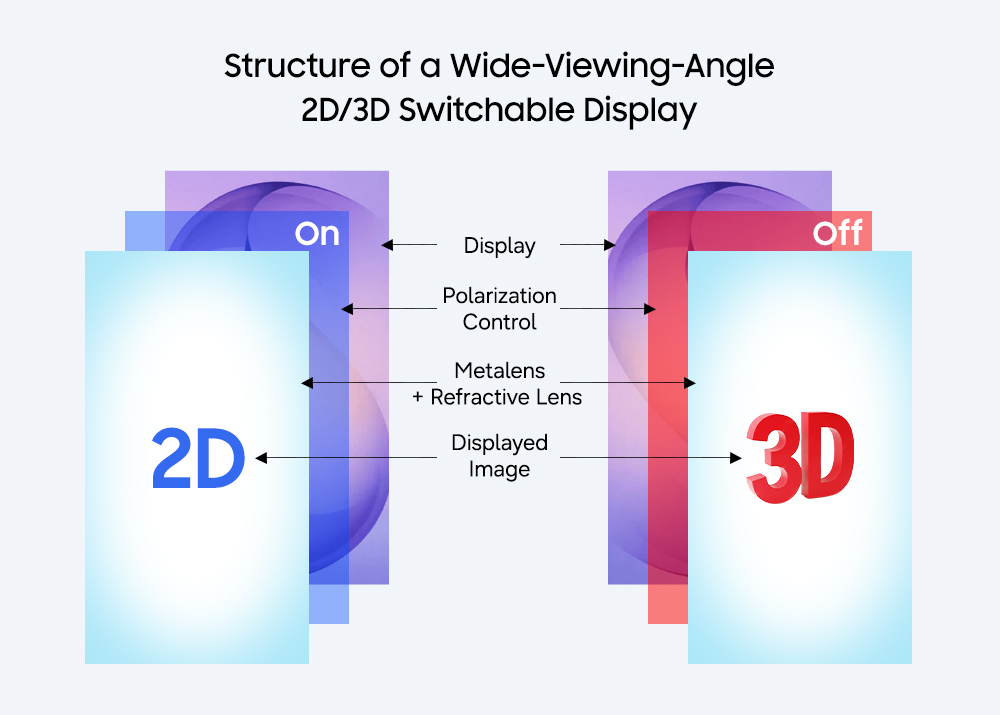
Illustration of a switchable 2D/3D display
The study is the first to demonstrate a meta-optical system capable of switching between 2D and 3D modes in a single device using voltage control. For end users, it’s a breakthrough that could eventually enable them to choose between high-resolution 2D for everyday tasks and immersive, multi-view 3D for video.
The system switches the metalens between concave and convex modes depending on the polarization controller in front of the display. For 2D viewing — such as reading or browsing — the metalens acts as a concave lens (controller on), offsetting the convex lens and allowing light to pass straight through like a flat pane of glass to produce a clear image.
For 3D content, the metalens becomes convex when the controller is off and works with the existing lens to enhance depth and widen the viewing angle. Through this, it can provide both the clarity of 2D and the depth of 3D simultaneously.
Thinner Design, Wider Viewing Angles
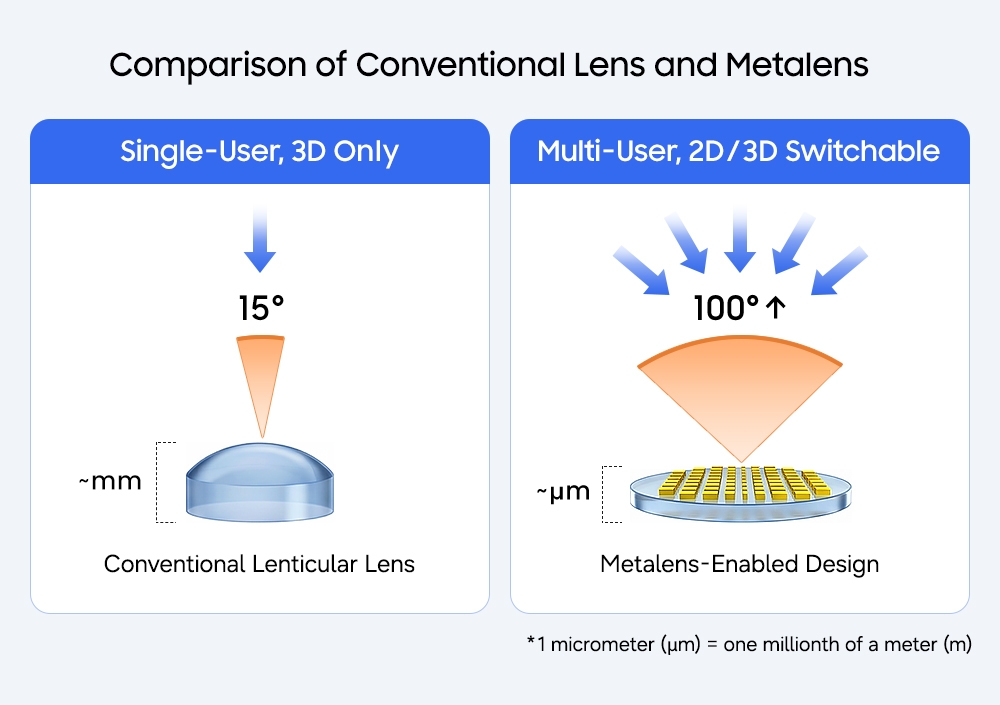
Comparison of a conventional lenticular lens and improved metalens
A major achievement of this research is the dramatic improvement in both thickness and viewing angle. Traditionally, high image quality and a wide viewing angle required large, thick lenses. The team’s MLL, however, features a high numerical aperture (NA)2 — enabling an ultra-thin profile of 1.2 mm and an ultra-wide viewing angle of up to 100 degrees. This represents more than a sixfold increase from the conventional 15-degree viewing angle, allowing multiple viewers to experience 3D content from different positions. It also demonstrates how nanoscale design can overcome the limitations of bulky optical systems.
A Step Closer to Commercialization
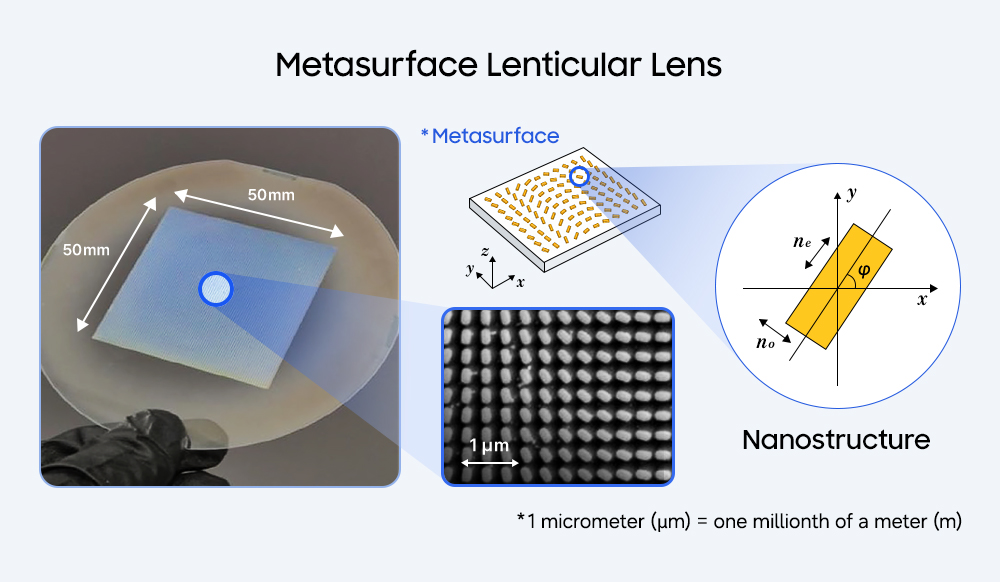
(From left) A fabricated MLL (50 × 50 mm, 25 cm²) and nanoscale structures enabling lenticular lens functionality
Beyond a simple proof of concept, the research demonstrates the practical viability of integrating metalens technology into real-world devices. The team fabricated a large-area metalens measuring 50 × 50 mm (25 cm²) and validated its use on OLED panels widely used in mobile devices.
This research was conducted in collaboration with the Visual Technology Team at Samsung Research, Samsung Electronics, and the POSTECH Nanoscale Photonics & Integrated Manufacturing Laboratory.
Looking ahead, this technology has the potential to reshape next-generation displays across smartphones, tablets and commercial systems.
From optical design and fabrication to real-time switching validation, Samsung and POSTECH have broken through a technological barrier. With the publication in Nature, Samsung further strengthens its leadership in meta-optics and next-generation display technologies.Beyond a simple proof of concept, the research demonstrates the practical viability of integrating metalens technology into real-world devices. The team fabricated a large-area metalens measuring 50 × 50 mm (25 cm²) and validated its use on OLED panels widely used in mobile devices.
(Photo credit: Samsung)


