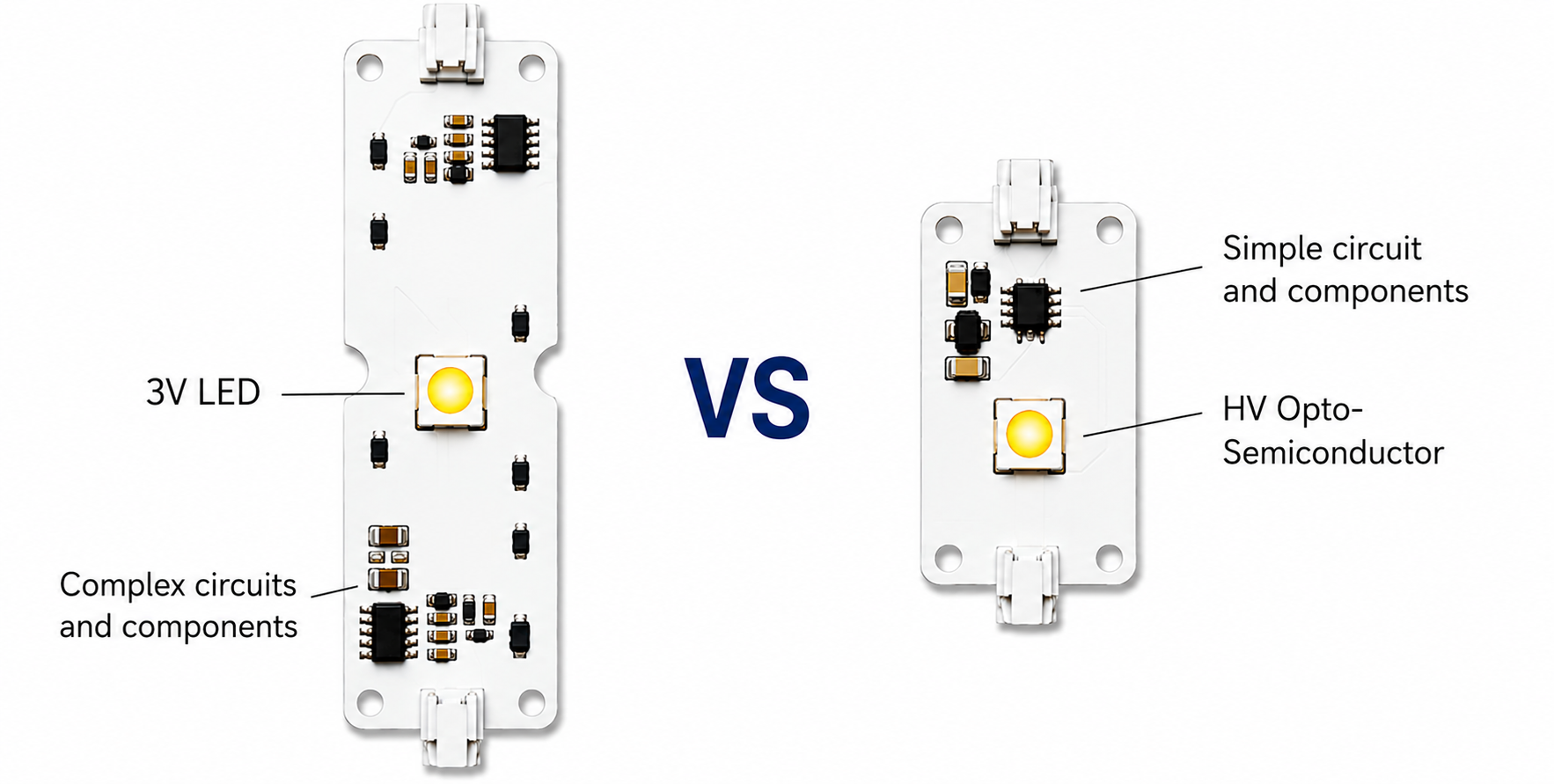
Seoul Semiconductor Co., Ltd., a global opto-semiconductor technology company, announced today that its world's first High Voltage (HV) opto-semiconductor technology has entered mass production with four of the world's top automotive brands across the Americas, Europe, and Asia, with plans to expand supply to 10 models by the end of the year.
The technology combines micro-scaled opto-semiconductor chips capable of 12V single-chip operation — as opposed to conventional 3V LEDs — with a high-voltage (HV) driver technology. This enables a reduction of more than 10% in the number of driver-related components used in hybrid and electric vehicles, while lowering power consumption by approximately 10%, contributing to cost reduction and simplification of automotive electrical systems. Seoul Semiconductor aims to leverage this global mass production rollout as a springboard to lead 'HV Opto-Semiconductor' as the next-generation standard technology in the hybrid and electric vehicle sectors, backed by its already-secured portfolio of hundreds of HV opto-semiconductor chip patents and more than 50 HV driver patents.
Seoul Semiconductor aims to leverage this global mass production rollout as a springboard to lead next-generation standard technology in the hybrid and electric vehicle sectors. The core of Seoul Semiconductor's 'HV Opto-Semiconductor' technology is based on a Multi-Junction P-N structure within a single chip. Conventional 3V drive systems required voltage step-down conversion by a factor of 1/100 when applied to hybrid and electric vehicles equipped with 300V high-voltage batteries. By contrast, applying a 30V HV chip reduces the voltage conversion ratio to just 1/10, significantly cutting conversion losses.
Previously, bridging such large voltage differences required multiple conversion circuits and components, resulting in substantial power loss, heat generation, and design complexity. Seoul Semiconductor's 'HV Opto-Semiconductor' technology minimizes the need for separate components, simplifying PCB design and reducing component count, while also lowering heat generation and improving durability. Compared to conventional 3V LEDs, it reduces driver costs by 20% and power consumption by 10%.
Matthew Fras, COO of North America Sales at Seoul Semiconductor, stated: "With global EV sales — including hybrids — set to surpass 20 million units this year, that number is expected to double to 40 million units in five years. As vehicles become more functionally advanced, the value of opto-semiconductors per vehicle is also projected to grow from $100 to $200, meaning the overall opto-semiconductor market will expand fourfold. We aim to significantly expand our market share through our 'HV Opto-Semiconductor' technology, with a goal of breaking into the global top 10 automotive brands by year-end, and we plan to elevate the automotive division to become the largest business unit within the Seoul Group this year."
According to the International Energy Agency (IEA), 1 in 4 (25%) new vehicles sold globally in 2025 will be hybrid or electric, with that share projected to more than double to over 2 in 5 by 2030. Global demand for automotive opto-semiconductors is also forecast to grow fourfold, driven by emerging functional requirements such as stylish lighting and vehicle-to-vehicle communication (TrendForce).
TrendForce 2025 Global Automotive LED Market- Lighting and Display Product Trend
Release Date:
1. PDF (196 Pages)- 30 June 2025
2. EXCEL- 30 June 2025 and 31 December 2025
Languages: Traditional Chinese / English
|
If you would like to know more details , please contact:
|


