Driven by global net-zero carbon emission targets and ESG policies, the smart building and energy-efficient lighting markets are experiencing rapid growth. This expansion is fueled by demands for improved energy efficiency, stricter regulatory requirements, and the growing need for digital management. According to the “Global Smart Building Market Size & Share” report by Fortune Business Insights, the size of the global smart building market is estimated at approximately USD 143 billion in 2025 and is projected to reach USD 548.5 billion by 2032, reflecting a CAGR of 21.2% during this period.
Initially, enterprises adopted smart LED lighting primarily to reduce energy consumption and electricity costs. Today, however, as the demand for building intelligence and comprehensive energy management rises, LED lighting systems have evolved from mere energy-saving devices into crucial information and control nodes within smart buildings.
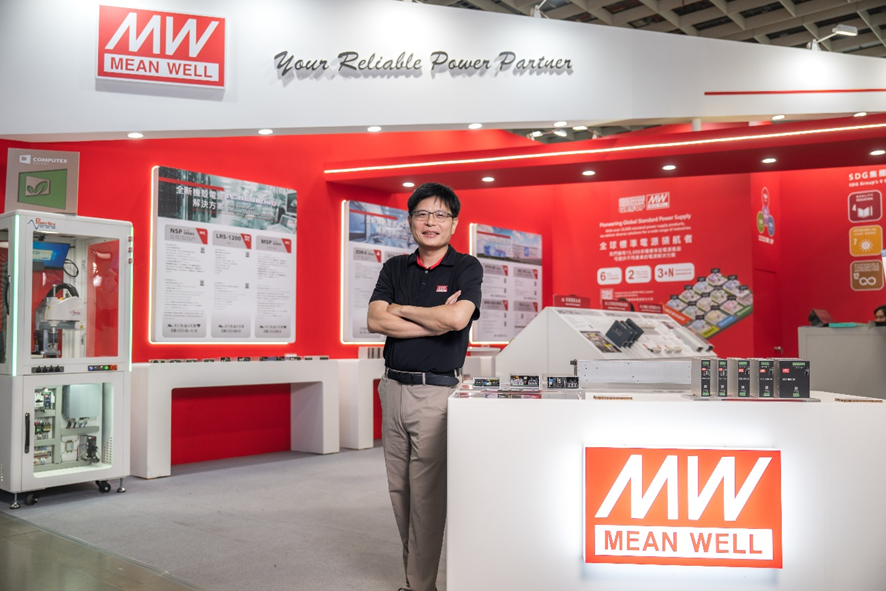
Tony Hsieh, Section Manager of the Technical Service Center at MEAN WELL, noted that as technologies such as smart control, healthy lighting, ambience management, and energy monitoring rapidly gain traction, the market’s focus has shifted from individual product performance to overall system integration capabilities. In real-world implementations, projects frequently require integrating equipment, communication protocols, and control systems from multiple brands. Consequently, balancing system stability, ease of maintenance, and future scalability has emerged as a major challenge for system integrators, building planners, and end-users alike. MEAN WELL stands out as one of the few industry players equipped to provide a comprehensive, one-stop solution. By leveraging an open architecture, the company provides ample flexibility for future expansions and upgrades, successfully addressing the diverse application demands of smart buildings, commercial offices, factories, and public facilities.
Building a Complete Ecosystem Through In-House R&D to Simplify Smart Lighting Integration
Recognizing the surging global demand for smart lighting, MEAN WELL has actively invested in the R&D of key technologies in recent years. By strategically integrating mainstream communication protocols such as DALI-2, KNX, and Modbus, the company has steadily transformed from a traditional power supply manufacturer into a comprehensive solutions provider. Today, MEAN WELL offers a complete smart lighting ecosystem comprising controllers, sensors, touch panels, LED drivers, and an energy management platform. Its extensive product lineup ranges from SPWM constant-voltage dimmable and color-tunable power supplies, DLS-2xx daylight sensors, and DTP-2xx touch panels, through to the EOS001 energy and environment monitoring platform.
While many so-called “one-stop” solutions exist on the market, most rely on products sourced from multiple brands. MEAN WELL’s greatest advantage lies in its in-house development for the vast majority of its portfolio, which significantly reduces the complexity of system integration. System integrators no longer need to study products from various suppliers, thus minimizing the time spent verifying cross-brand compatibility. Furthermore, MEAN WELL continuously refines its operational interfaces and functional designs based on market feedback. Whether configuring scene settings, system scheduling, or device management, users can execute tasks more intuitively, thereby shortening project implementation times and boosting overall deployment efficiency.
Hsieh reiterated that for system integrators, the most significant pain points remain compatibility verification and steep learning curves. When a system comprises products from multiple suppliers, integrators must simultaneously master the distinct setup methods and control logics of different brands, thereby adding a heavy burden to project execution and maintenance. Consequently, the market is increasingly shifting toward integrated solutions that aim to mitigate integration risks and lower implementation barriers by adopting a complete product portfolio from a single brand. This industry trend underscores MEAN WELL’s focus on providing comprehensive smart lighting solutions.
From Control Interfaces to LED Drivers: Enhancing Competitiveness in DALI-2 Applications
MEAN WELL’s DTP-2xx series touch panels fully support the mainstream DALI-2 protocol. Designed with the user experience in mind from the outset, these panels enable flexible scene control for various lighting environments. Beyond basic operations, the design accounts for residential use, where panel backlights and prompt sounds could potentially disrupt sleep. To address this, users can adjust backlight brightness and alert volumes directly on the hardware, or completely disable the lights and sounds to suit their specific needs. Furthermore, MEAN WELL provides custom laser engraving services, allowing system integrators to personalize button text or icons—such as “Bedroom,” “Reading Mode,” or “Theater Mode”—based on project requirements. This customization not only improves user convenience but also adds premium value to high-end residential and commercial spaces.
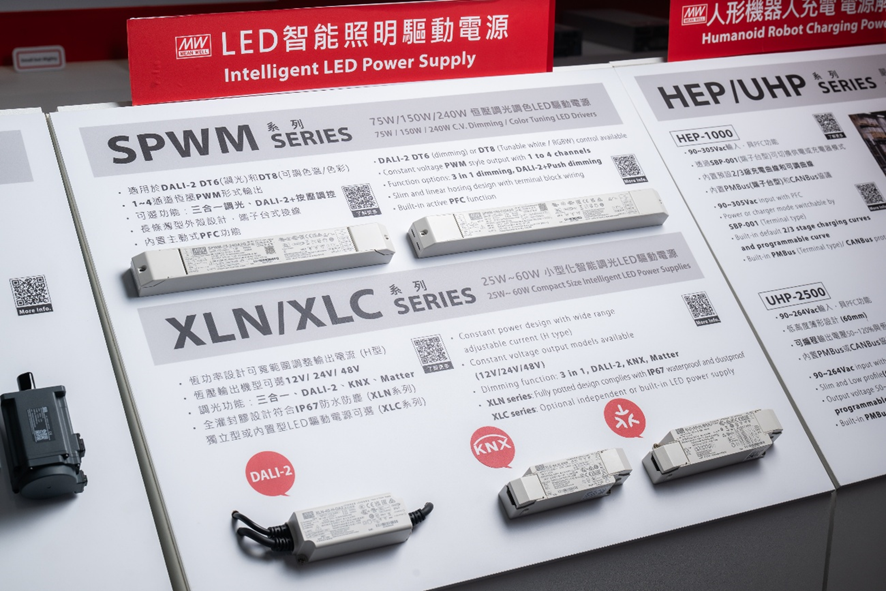
To meet the rapidly growing market demand for applications related to LED light strips, MEAN WELL has introduced the SPWM 75, 150, and 240 series of constant-voltage dimming/ color tuning LED drivers. With power outputs ranging from 75W to 240W, these drivers easily satisfy the requirements of residential and most commercial environments. Unlike traditional drivers limited to simple brightness adjustments, the SPWM series features a built-in four-channel output, supports the DALI DT8 standard, and supports both dimming and tunable white control . While a traditional single-channel setup only controls independent lighting zones, the dual-channel mode allows for the precise color mixing of warm and cool white light. Additionally, the four-channel mode supports comprehensive RGBW applications, perfectly catering to the atmospheric lighting needs of commercial spaces, hotels, and entertainment venues.
“Securing DALI-2 certification is no easy task,” explained Hsieh. “The challenge is that DALI systems must support multiple terminal devices simultaneously, meaning international standards strictly cap the power consumption of each individual device. In short, the product must maintain stable, extensive sensing capabilities under extremely low power conditions.” Hsieh added, “By leveraging years of technical expertise in DALI product development and power supply design, MEAN WELL optimized its circuit architecture and hardware to successfully balance low power consumption with high performance, thus achieving certification. System integrators can also access product information through the official DALI database, further enhancing credibility and interoperability in international markets.
Smart Sensing Elevates Energy Efficiency: DALI-2 Certified DLS-2xx Series for Diverse Applications
Complementing the DTP-2xx series, MEAN WELL’s DLS-2xx smart sensor series targets the automated control requirements of smart lighting systems. As lighting usage patterns vary dramatically across different environments—such as offices, corridors, warehouses, and public spaces—the adaptability of sensing devicest is critical to optimizing overall system performance.
To address these diverse application needs, the DLS-2xx series features various sensing ranges and detection angles, ensuring optimal configuration based on a room’s dimensions and specific use cases. Whether a project requires low-ceiling installations in standard offices or high-ceiling setups in warehouses and tall buildings, the series offers specific models to ensure flexible, highly effective deployment.
Hsieh pointed out that the DLS-2xx sensors can detect shifts in ambient light and monitor occupancy, automatically adjusting lighting brightness and switching timing accordingly. This prevents lighting fixtures from operating unnecessarily for prolonged periods, thus significantly boosting energy efficiency. Through intelligent control, the system effectively cuts energy consumption while simultaneously enhancing spatial comfort and safety. Furthermore, the DLS-2xx seamlessly integrates with DALI-2 lighting systems to support zone control and scene management. This deep integration empowers building or facility managers to implement more refined, area-specific lighting strategies, ultimately maximizing the energy-saving potential of any smart building.
From Lighting Control to Comprehensive Energy Management: Capturing the ESG Market
As ESG initiatives gain momentum, modern enterprises can no longer simply set energy-saving targets; they must back up their progress with concrete data. Metrics such as electricity consumption and carbon emissions now require transparent, data-driven reporting. To this end, MEAN WELL has expanded its strategic focus beyond smart lighting and into the broader fields of ESG and energy management. The newly launched EOS001 energy and environment monitoring platform integrates key data, including air quality, water consumption, and electricity usage. This empowers enterprises to establish fully digital energy management systems.
Hsieh stated that the EOS001 platform utilizes the Modbus communication protocol, allowing it to seamlessly integrate with MEAN WELL’s DALI-2 control systems. This connectivity unites energy monitoring and lighting control to form an intergraded smart building management platform. To maximize the effectiveness of this solution, MEAN WELL has adopted an ecosystem collaboration model. Specialized partners provide modules, such as air quality sensors, which are then jointly brought to market through MEAN WELL’s global distribution channels, delivering customers a more robust and complete solution.
Furthermore, MEAN WELL intends to deepen its footprint within the DALI-2 ecosystem and the broader LED lighting sector, accelerating its transition from a product supplier to a system solutions provider. While continuously strengthening core product lines—such as LED drivers, lighting controllers, operation panels, and sensors—the company will also focus on enhancing the integration capabilities of its lighting control systems to build a more seamless smart lighting architecture. In terms of technological development, MEAN WELL will further integrate sensing technologies, communication protocols, and energy management functions. This strategic direction will strengthen its integration capabilities for smart buildings and IoT applications, ultimately elevating the intelligence and automation of its lighting systems.
Promoting “Demo Site” Initiatives Worldwide to Help Channel Partners Transition into Service Providers
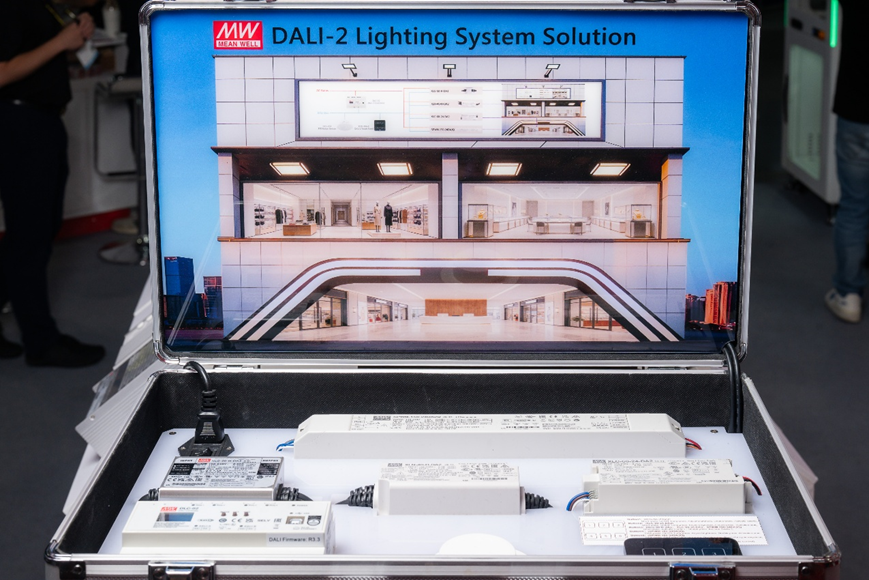
As we enter the era of smart buildings and lighting, customers place significant value on system integrators’ planning capabilities. To ensure distributors fully understand and can effectively promote these smart lighting solutions, MEAN WELL has actively spearheaded demo kit and “Demo Site” initiatives in recent years, assisting global partners in establishing physical demonstration spaces. The core objective of this program extends beyond merely displaying products; it is designed to help distributors transition from a traditional component sales model to providing comprehensive solutions.
Once MEAN WELL helps distributors set up these “Demo Sites”, partners can learn the entire development process of a smart lighting system firsthand—from product selection and system integration to software configuration and scenario demonstration. As a result, they acquire the practical, hands-on capabilities needed to deliver end-to-end solutions for clients across diverse industries.
Hsieh explained that because the budget for a smart lighting project can easily reach hundreds of thousands of dollars, customers naturally place a high premium on a distributor’s post-installation maintenance and technical service capabilities. When clients can witness the system’s operational results with their own eyes, they are significantly more willing to adopt the proposed solutions. To date, MEAN WELL has established over 12 state-of-the-art “Demo Sites” worldwide. The company plans to add more than 18 new locations in 2026, further strengthening its global smart lighting channel network.
With intelligence and sustainability shaping the future of the global building industry, competition has shifted away from the specifications of individual products toward system integration and ecosystem value. Driven by one-stop solutions, cross-industry partnerships, and a transformed global distribution network, MEAN WELL is steadily evolving from a traditional power supply manufacturer into a key player in smart lighting and energy management platforms.


