Supercapacitor Powers LED Flash

Advanced Analogic Technologies has introduced a 2-MHz boost-converter IC that uses a supercapacitor to provide a large peak current to an LED-flash system. The 2A AAT1282 flash driver incorporates I2C control and accepts input voltages of 2.7 to 5.5V. Designers can use the device's two 1A current sinks to drive two LEDs and can parallel these outputs to drive one 2A LED. The IC allows designers to set 16 levels for movie, or "torch," mode and has a true-load-disconnection feature that guarantees a shutdown current of less than 1 μA. The device achieves 90% efficiency with a 1-μH inductor.
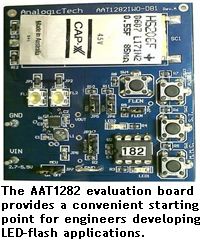
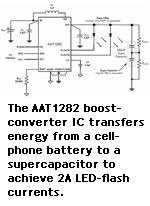
Using a supercapacitor to provide for a reservoir of current, the product protects the battery from high-discharge events and allows LED brightness approaching that of a xenon flash. The 0.55F supercapacitor comprises two 2.5V capacitors so that the IC can always operate in boost mode. The circuit also includes 2.2-μF ceramic capacitors to reduce ac-circulating currents, yielding lower EMI (electromagnetic-interference) emissions and ensuring that current from the supercapacitor doesn't flow back into the battery.
The AAT1282 is available in a 14-pin, 3×3-mm, TDFN (thin-dual-inline-flat) package with a suggested retail price of $1.75 (1000). The IC operates across a -40 to +85°C temperature range.

Disclaimers of Warranties
1. The website does not warrant the following:
1.1 The services from the website meets your requirement;
1.2 The accuracy, completeness, or timeliness of the service;
1.3 The accuracy, reliability of conclusions drawn from using the service;
1.4 The accuracy, completeness, or timeliness, or security of any information that you download from the website
2. The services provided by the website is intended for your reference only. The website shall be not be responsible for investment decisions, damages, or other losses resulting from use of the website or the information contained therein<
Proprietary Rights
You may not reproduce, modify, create derivative works from, display, perform, publish, distribute, disseminate, broadcast or circulate to any third party, any materials contained on the services without the express prior written consent of the website or its legal owner.

microLEDs: from headlamps to the data center When we think about the evolution of AI technology, developments in machine learning and large language models come readily to mind, as do the latest graphics processing units (GPUs), high-bandwidth... READ MORE

The question of what makes a building "smart" has been debated in the industry for years. ams OSRAM provided a clear answer at Light + Building 2026: it is light — not as illumination, but as a sensory nervous system. It percei... READ MORE