As generative AI continues to penetrate the consumer electronics market, “lightweight AI glasses” have made significant inroads. Amid this rapid growth, an industry consensus has seemingly emerged around the notion that “AI is a must for AR glasses.” Against this backdrop, video-centric AR glasses, known for their “portable giant screens” yet lacking standalone computing power, are seeing their market position being challenged. Nonetheless, both user demand and current technology roadmaps suggest that these devices are likely to remain highly relevant over the short-to-mid term. According to TrendForce’s 2025 Near-Eye Display Market Trend and Technology Analysis, global AR glasses shipments reached an estimated level at 620,000 units in 2025. Of this total, video-centric products that incorporate Birdbath optical solutions and OLEDoS displays accounted for more than 50% of the market.
Video-centric AR glasses are designed to deliver high-resolution, highly immersive personal viewing experiences. They primarily target business professionals with limited living space or frequent travel needs, as well as consumers who place a premium on gaming and audiovisual content. For this demographic, the core selling points are display performance, including higher PPD (pixels per degree), a wider FoV (field of view), and superior color rendering and image quality, rather than AI assistant functionality. TrendForce indicates that forcing edge AI integration could be counterproductive, leading to increased overall device weight, shorter battery life, and inflated costs.
In terms of product design, current video-centric AR glasses are essentially lightweight and portable displays rather than AI data carriers. They stand out in the market in three main areas. First, they can leverage OLEDoS technology to achieve high resolution and refresh rates, creating the visual equivalent of a 100-inch or larger virtual screen. Second, they feature lightweight and translucent designs weighing only 70-80g, offering immersive experiences while improving wearing comfort. Third, they boast broad compatibility, enabling connectivity with smartphones, PCs, and gaming consoles through “plug-and-play” Type-C ports.
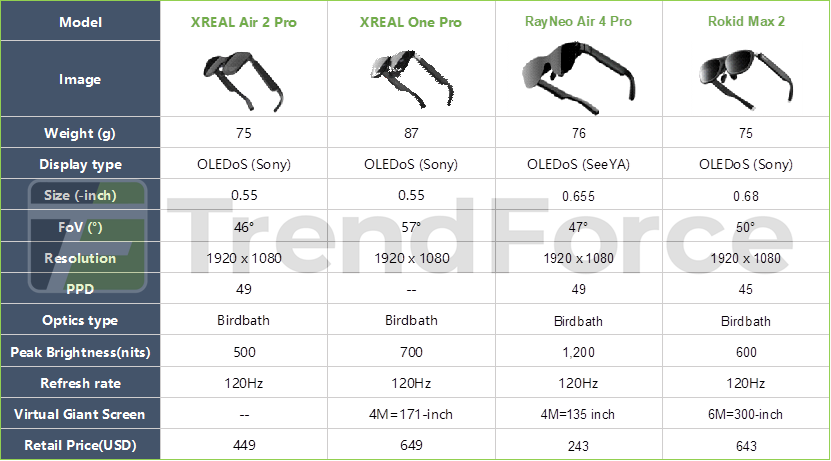
Source: Product portfolios from multiple brands, compiled by TrendForce.
In the mid-to-long term, video-centric AR glasses will face two major challenges. First, their market adoption will be limited by their sole utility as a multimedia player. Second, they will confront an increasing threat of substitution as VR/MR devices become lighter and thinner. Even within the AR domain, other types of full-color AR glasses are looming on the horizon, poised to cannibalize their customer base with greater computing power and spatial interaction capabilities. To fend off these pressures, major brands in this segment, including XREAL, RayNeo, Rokid, Viture, and INMO, have centered their sales pitch on enhanced display performance, such as HDR and 10-bit color depth.
TrendForce notes that AR applications are still in an early exploratory stage. Although video-centric AR glasses lack edge AI support and face mounting pressure from both VR/MR and full-color AR alternatives, they can still carve out a niche in audiovisual entertainment through continued improvements in display performance and wearing comfort.
Author: Christine / TrendForce
TrendForce 2025 Near-Eye Display Market Trend and Technology Analysis
Publication Date : 29 August 2025
Language : Traditional Chinese / English
Format : PDF
Page Number: 168
|
If you would like to know more details , please contact:
|


