AR glasses have become a fundamental gateway to AI deployment and phygital interactions. Businesses are all racing to gain a strong foothold in this AR wave. Chinese brands are raising entry barriers through local digital ecosystems and market segmentation, while overseas tech giants such as Meta and Google are leveraging strategic partnerships, as well as autonomous large models and platforms to strengthen software-hardware integration and customer stickiness, thereby expanding their market share.
Chinese brands are rapidly building competitive moats with mature supply chain capabilities and highly concentrated local digital systems. Take Alibaba’s Qwen AI Glasses as an example: this new product leverages enhanced AI agents to integrate everyday apps such as Taobao and Alipay to develop a closed-loop ecosystem and sticky customer habits. Moreover, the Chinese market has evolved toward market segmentation in “the Hundred Glasses’ War.” The market has increasingly taken root in specific life scenarios, as shown in iFLYTEK’s featured live translation AR glasses and Dreame’s professional AR swimming goggles.
At the same time, the deep integration between video and AI has escalated the AR warfare to a higher level. With first-person visual input from the glasses, AI can retrieve a myriad of visual resources to facilitate training and better understand real-world dynamics, thereby enabling more tailored application scenarios. In the race for AI deployment, international tech giants are also mobilizing their powerful resources in an attempt to secure dominance in the next stage of development.
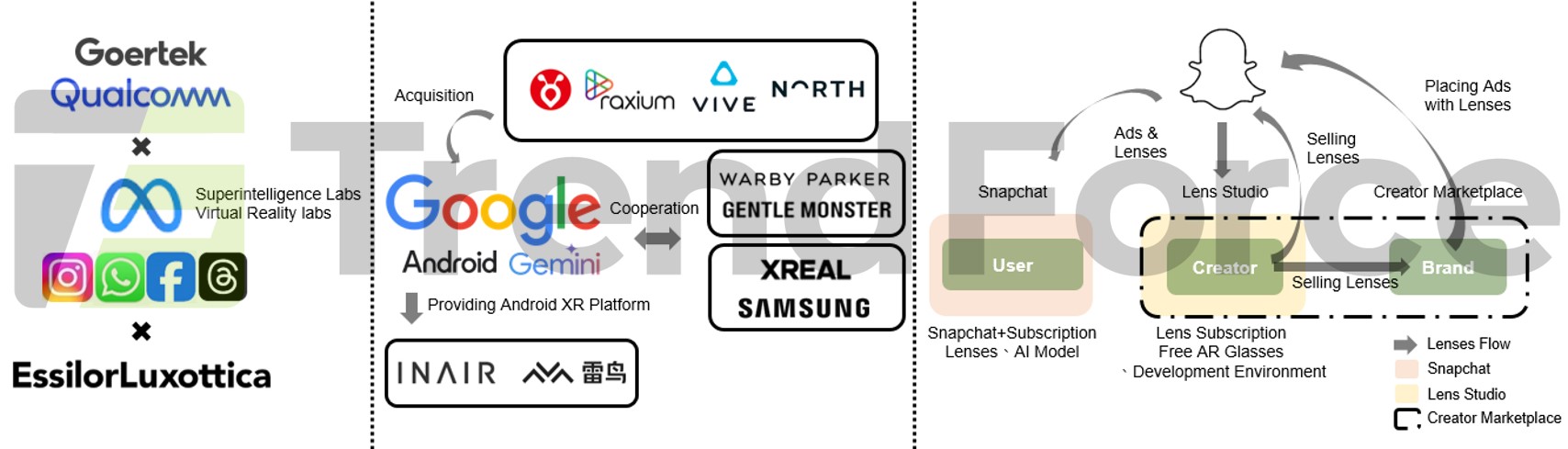
With a long history of near-eye display development, Meta further established a strategic partnership with global eyewear leader EssilorLuxottica to bring AR glasses to everyday life. At the core of its content generation lies its in-house Llama large language model, which reinforces deep reasoning and personalized agent capabilities. Furthermore, voice control, live translation, and features such as Spotify are integrated to effectively channel data from hardware to its powerful software communities.
Google is fortifying its hardware fortress by acquiring companies like Raxium and North while scaling up hardware-software integration by working with XREAL and Samsung. The company also launched Android XR, an operating platform highly integrated with Gemini AI, to address the key challenge of building content in the ecosystem of AR brands. To date, RayNeo and INAIR have adopted this platform. Additionally, Google partnered with Gentle Monster to enhance product aesthetics, closing the gap between tech products and consumers.
Meanwhile, Snap demonstrates its unique community appeal through Lens Studio, a filter creation platform. Besides offering glasses rental services to lower development barriers for creators, the company is preparing to launch its next-generation model in 2026, featuring a more compact design with built-in batteries. With the integration of cutting-edge AI models and native social media functionalities, the company has envisioned AI-empowered life experiences for creators by fostering a more immersive environment and lowering barriers to content creation.
From the local ecosystem led by Alibaba to platform-based deployments from tech leaders like Meta and Google, the future of AR glasses is no longer restricted to hardware upgrades. Rather, it is emerging as a gateway to AI and real-world interactions. In the race for transnational market dominance, the winning edge will hinge on the ability to most seamlessly incorporate AI power into users’ daily lives and emotional connections.
Author: Emerson / TrendForce
TrendForce 2025 Near-Eye Display Market Trend and Technology Analysis
Publication Date : 29 August 2025
Language : Traditional Chinese / English
Format : PDF
Page Number: 168
|
If you would like to know more details , please contact:
|


