Amid mounting margin pressure and slowing growth in the LED industry, players are moving beyond traditional segments in search of new momentum, with MicroLED emerging as a key focus. According to MicroLED-info, Seoul Semiconductor plans to invest KRW 250 billion (around $180 million) over the next five years, primarily in the R&D and production of microLED microdisplay modules for AR applications.
The report suggests that the company has embarked on a government-approved restructuring plan as its core LED package business faces mounting pressure from falling prices and weakening profitability. Under the initiative, the new displays will be built on Seoul Semiconductor’s proprietary WICOP (Wafer Integrated Chip on PCB) technology, the report adds.
As noted by Maeil Ilbo, founded in 1992, Seoul Semiconductor supplies LED packages across lighting, automotive, and IT, and holds about a 4.8% global share in the optoelectronics market. Despite its proprietary wire-free WICOP technology, the company has come under pressure from persistent price declines and softer demand, weighing on margins, the report explains.
French MicroLED Startup Achieves Key Milestone
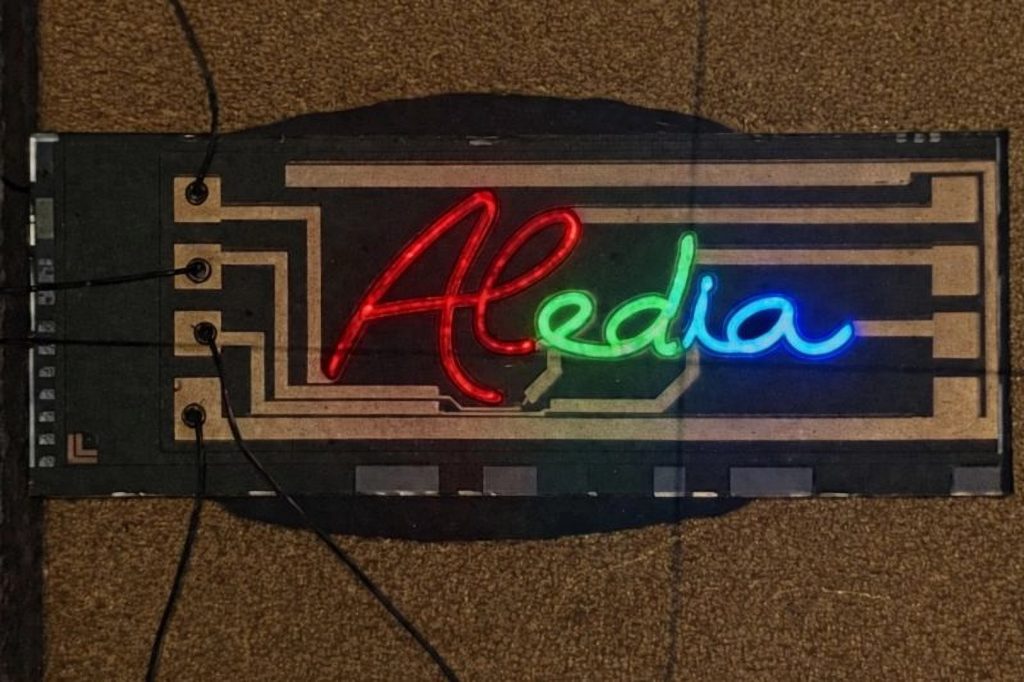
On the other hand, French startup Aledia, according to MicroLED-info, has successfully demonstrated a fully functional monolithic RGB epitaxial wafer, marking a key milestone for the technology. The achievement validates the company’s end-to-end monolithic RGB process, enabling red, green, and blue emission from a single epi wafer fabricated in a single run, the report notes.
According to the company, its proprietary nanowire-based architecture can grow nanowires in a single processing step, with diameters ranging from 100 nm to 400 nm depending on the target wavelength, enabling full RGB capability within one unified structure.
On device performance, the company demonstrated a 2.5 μm sub-pixel pitch—equivalent to a 5.0 μm × 5.0 μm pixel size—and outlined a roadmap to further shrink this to 2.0 μm for both monochrome and monolithic RGB displays, MicroLED-info suggests.
In parallel, Aledia has validated its 9V microLED devices on 200 mm silicon wafers, including 15×30 μm blue emitters on the same platform. The company also confirmed the commercial availability of its 3D-Nano microLED technology built on 200 mm silicon in February, the report adds.
(Photo credit: Aledia)
TrendForce 2025 Near-Eye Display Market Trend and Technology Analysis
Publication Date : 29 August 2025
Language : Traditional Chinese / English
Format : PDF
Page Number: 168
TrendForce 2025 Micro LED Display and Non-Display Application Market Analysis
Release: 29 May / 30 November 2025
Languages: Traditional Chinese / English
Format: PDF
Page: 119
|
If you would like to know more details , please contact:
|


