As the global display industry evolves, LED displays gradually shift from a singular pursuit of physical performance toward a return to energy-efficiency value. In the early stages, competition centered on peak brightness, color saturation, and ever-finer pixel pitch. Today, in the era of ultra-high-definition (UHD) displays, heat generated by high power consumption has become a growing constraint—creating “thermal anxiety” that limits further performance breakthroughs.
In recent years, companies including Leyard, Unilumin, Ledman, and Absen have promoted “cold LED screens” (energy-efficient LED screen with low heat) as core product labels, aiming to enhance system stability and longevity by reducing display temperature. Meanwhile, terminal brands such as Hisense and TCL highlight energy efficiency and precise thermal control as key selling points for their latest RGB-Mini LED and SQD Mini LED TVs—signaling that energy efficiency has emerged as a foundational consensus across the value chain rather than a secondary metric.
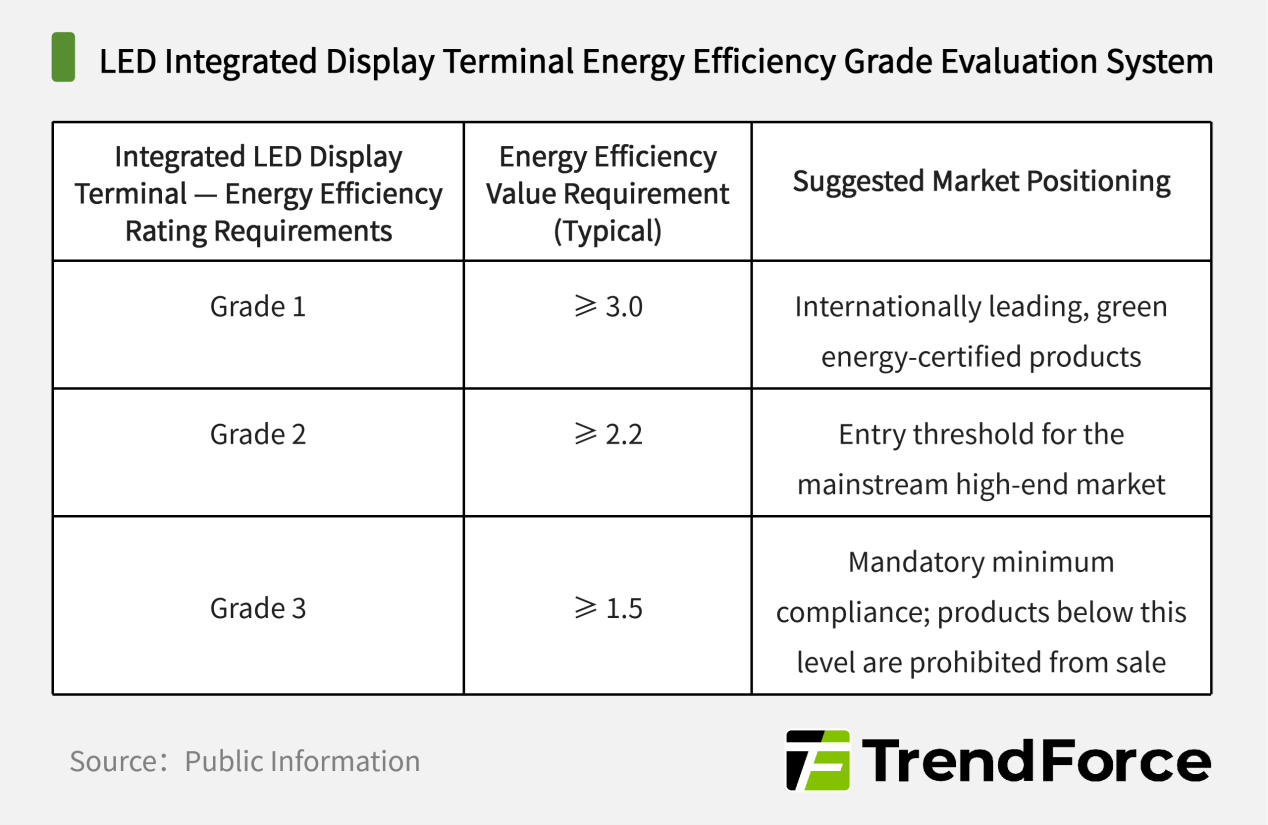
Behind this shift lies both the global carbon neutrality agenda and the formal implementation of China’s mandatory national standard Minimum Allowable Values of Energy Efficiency and Energy Efficiency Grades for Displays (GB 21520-2023). Against this backdrop, LED driver ICs—acting as the “gatekeepers” that regulate energy allocation across millions of pixels—are being reassessed in terms of both value contribution and strategic importance.
Performance vs. Power in the UHD Era: Driver ICs Take Center Stage
As LED displays advance toward sub-P1.0 and even finer pixel pitches, pixel density increases geometrically. The surge in LEDs per unit area drastically compresses thermal dissipation space. Heat accumulation not only raises surface temperature but also triggers ripple effects physically.
For instance, red LED chips are highly temperature-sensitive: for every 1°C rise in ambient temperature, luminous efficiency declines by approximately 1%. Localized temperature differentials across large-format displays can therefore result in visible color inconsistency and white-balance drift.
Prolonged high-temperature operation also accelerates encapsulation yellowing and thermal fatigue in driver IC packaging materials, which evidently reduce mean time between failures (MTBF). In high-load scenarios such as virtual production or command-and-control centers—where displays run at high brightness for extended periods—thermal failure can even lead to system shutdowns. Thus, it is urgent to resolve the tension between display uniformity and system reliability.
From a power-consumption perspective, while pixel density scales quadratically with pitch reduction, improvements in single-LED luminous efficacy and lower operating current have slowed—or even reduced—the total power share of LED chips. In contrast, the power consumption of traditional 16-channel driver IC architectures rises sharply, emerging as a new energy-efficiency bottleneck.
According to LED driver IC manufacturer XM-Plus, in certain ultra-fine-pitch products (below P0.7), the share of power consumed by driver ICs and associated circuitry can surge from the conventional 15–30% range to 50% or higher under varying brightness conditions. In effect, the driver IC now directly determines display temperature, performance, and operational lifespan.
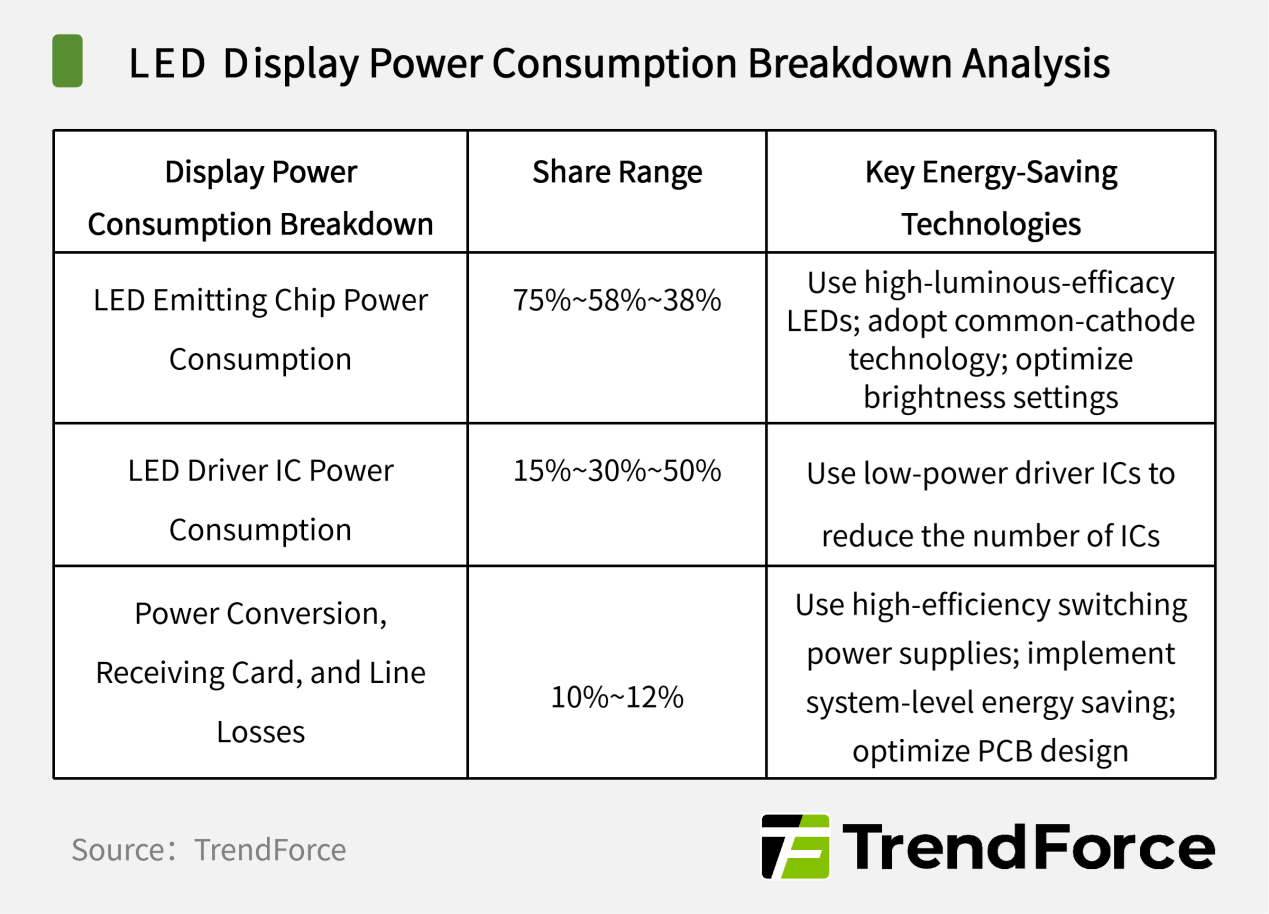
A 10% improvement in driver IC conversion efficiency can deliver a significantly greater impact on overall system energy performance than incremental gains in LED chip luminous efficacy alone. Taking XM-Plus’ 2024 XM11206G as an example, its energy-saving architecture reduces Power/Pixel consumption by 20% in black-screen static mode compared with the previous generation. Applied to a 4K display integrating over 8 million pixels, the cumulative energy savings and thermal reduction are substantial.
With GB 21520-2023 in force since June 1, 2024, clear energy-efficiency thresholds and grading criteria have been set in place for the display industry. For panel manufacturers, deploying high-efficiency driver ICs is no longer an optional optimization—it is a regulatory requirement and a prerequisite for market access.
Energy Efficiency as Core DNA: Branding the IC Technology Path
High-performance, energy-efficient driver ICs typically adopt highly integrated common-cathode architectures. On this technological path, XM-Plus has positioned itself as a representative player.
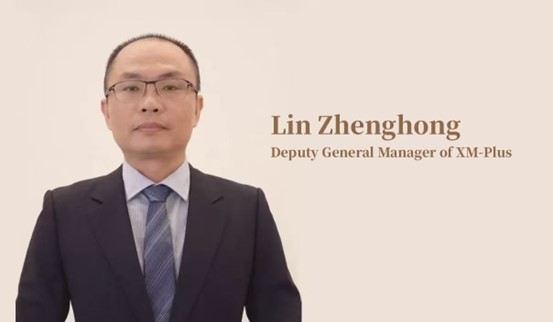
“Since our founding, energy efficiency has been embedded in our technical DNA,” said Lin Zhenghong, Deputy General Manager of XM-Plus. “Our early investment in common-cathode driver technology reflects our long-term pursuit of the optimal balance between performance and power consumption.”
XM-Plus has diversified across self-emissive display driver ICs, interface bridge chips, and automotive display drivers. Its self-emissive display driver IC series has been successfully adopted into high-end product lines of Samsung in 2025.
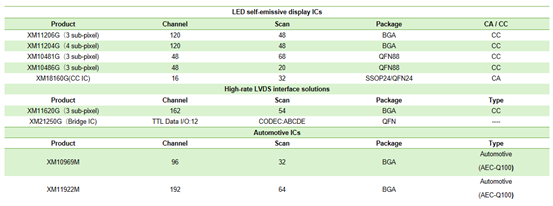
Due to its exceptional performance in virtual production, the XM10486G series has been listed by leading video processor provider Brompton Technology, whose ecosystem partners include Sony, Unilumin, Absen, Aoto and AUO, among others.
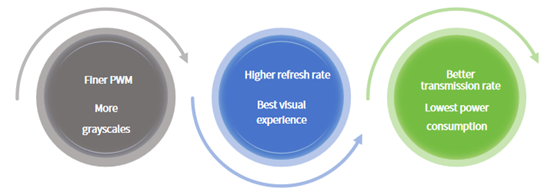
The upgraded XM11206G series pushes industry benchmarks further, representing a perfect fit for fine-pitch LED displays and low-temperature “cold LED screens”, with remarkable characteristics as follows:
-
18-bit color depth for refined grayscale at low brightness
-
Ultra-high refresh rates up to 15,360Hz, eliminating scan-line artifacts in professional filming
-
20% lower Power/Pixel consumption in black-screen static mode versus the prior generation
On the cost side, Lin pointed out that the high-end display market can bear higher premiums for driver ICs, but only if the core pain points are resolved.
In large-scale stage rental scenarios, traditional “hot screens” require high-capacity generators and noisy cooling systems, increasing both cost and operational complexity. A “cold LED screen” solution based on XM-Plus’ architecture can reduce total system power consumption to roughly 30% of conventional designs, and then lower generator capacity requirements and on-site cooling demands.
By deepening its expertise in high-integration, common-cathode driver ICs, XM-Plus has established a solid foothold in the premium segment while transitioning from project-based customization toward a scalable, brand-driven IC platform strategy. Importantly, its expansion into common-anode architectures represents not a compromise in performance, but a value extension—maintaining energy-saving advantages exceeding 50% at the system level.
AI Integration Expands the Driver IC Frontier
XM-Plus’ strategic transformation coincides with broader revolution in the display industry. The convergence of AI and display technologies is opening new application frontiers. With the surge in AI-generated content (AIGC), large-format LED screens are evolving into interactive AI visual carriers. HDR, high-contrast, and high-refresh-rate AI-generated content demands greater real-time processing capabilities from driver ICs.
Future driver ICs may integrate edge-computing algorithms for low-grayscale calibration, color enhancement, and dynamic power forecasting—further elevating their role within the system architecture.
As AI expands display use cases—from advertising to immersive simulation, public interaction, and personal AI visual spaces—the driver IC market is poised for structural growth. In other words, driver IC manufacturers like XM-Plus will embrace a brilliant future with more business opportunities.
According to TrendForce, the global LED display driver IC market remains highly concentrated, with the top five vendors accounting for approximately 83% market share in 2025. Yet new entrants continue to emerge.
Lin emphasized that XM-Plus’ competitive edge lies not in pursuing cost-insensitive perfection, but in delivering over 90% of premium display performance at optimized cost—achieving the best balance between performance and efficiency. By refining PWM control granularity, the company ensures accurate color rendering even at ultra-low current levels.
Looking ahead, XM-Plus is also targeting MIP (Micro LED in Package) technology, leveraging its yield and cost advantages to accelerate Micro LED commercialization with tailored low-current, cost-optimized IC solutions.
Amid tight global 12-inch wafer capacity and rising memory component prices driven by AI chip demand, XM-Plus has mitigated supply-chain volatility through strategic foundry partnerships and flexible product-line design.
The company expects to maintain annual growth of around 40% in the coming years, with revenue projected to exceed CNY 150 million in 2026.
Conclusion
The popularity of “cold LED screens” reflects more than a marketing trend—it signals a structural revaluation of LED driver ICs. Their rising importance is both a technological inevitability and a value realignment driven by industry-wide consensus.
Companies such as XM-Plus, by resolving the core tension between performance and power consumption, fortifies the technological foundation of LED displays. From professional virtual production to mass-market branding, from alleviating thermal constraints to enabling AI-era interactivity, high-efficiency driver ICs are reshaping the value chain of LED displays—building a visual future that is brighter, more authentic, and distinctly cooler.
(Author/Translator: Janice/TrendForce)


