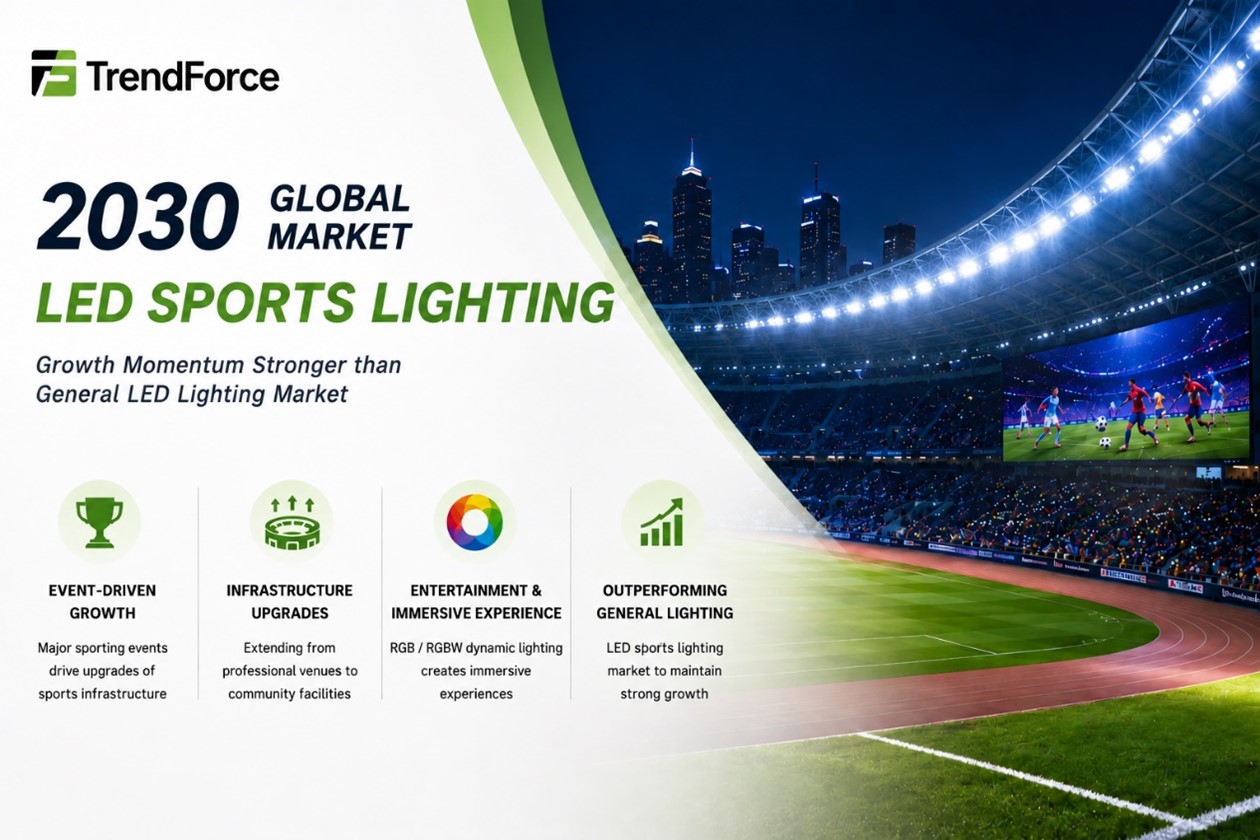
According to TrendForce’s latest research, the global LED sports lighting market is entering a new wave of explosive growth. Driven by the full momentum of sports events at all levels worldwide, such as the 2026 FIFA World Cup, global sports facilities have started going through a cycle of large-scale upgrades and renovations. Demand in the LED sports lighting market is no longer restricted to top-tier professional sports venues. Instead, there has been a clear trend of mass-market penetration, expanding the market from professional stadiums to community recreational facilities. Moreover, the LED sports lighting market is increasingly integrating with entertainment and stage technologies, indicating a growing demand for color-changing (RGB / RGBW) capabilities and more precise dynamic lighting control systems to support more immersive experiences. With major sports events such as the 2028 Olympics in Los Angeles and the Centennial of the FIFA World Cup in 2030 taking place one by one, the LED sports lighting market is expected to sustain growth, potentially reaching USD 1.451 billion by 2030, showcasing robust growth substantially higher than that in the LED general lighting market.
The mainstream product categories in LED sports lighting are LED floodlights and high/low bay lights. Based on application scenarios, the market is primarily divided into two major segments: large-scale outdoor sports complexes that host events such as football and track and field, and indoor sports arenas specifically tailored for sports like basketball, volleyball, and gymnastics.
Technical specification requirements for sports LED floodlights have become more demanding every year. First, luminous flux and efficacy performance have increased significantly. For high-end products, the predominant luminous flux has increased to the 100,000-300,000lm range, while efficacy performance, driven by increasing power density, has remained high over the years, such as Musco Lighting’s flagship solution TLC for LED and Thorn’s Altis Gen 5 floodlight.
Second, TV broadcasting applications further require 8K-ready broadcast illumination and high-TLCI color rendition, ensuring flicker-free 8K video capture at high frame rates. For instance, Signify’s Philips ArenaVision LED Gen 4 maintains a precisely controlled color temperature at 5700K, a high TLCI (>90), and a low flicker level (<1%), specifically tailored to optimize slow-motion capture for 8K displays and address the issue of video flickering at high frame rates.
Notably, demand for immersive experiences as well as interactive and entertainment scenarios continues to grow, making RGB/RGBW color-changing modules a new market spotlight. For example, Acuity Brands’ M3 series incorporates an RGB color module in its professional white-light module. This solution eliminates the need for additional stage lighting equipment, allowing stadiums to achieve dynamic color effects through DMX input. Another example is the new RGBW dynamic multi-color ALTIS Gen 5 developed by Thorn, Zumtobel’s subsidiary. This three-module product features adjustable tilting and orientation settings, delivering a luminous flux of up to 256,000lm with an efficacy of 160lm/W. It also meets the flicker-free requirement (TLCI 90+) for HDTV broadcasting and supports DALI-2 or DMX control systems.
Author: Christine Liu, Senior Analyst of TrendForce
TrendForce 2026 Global LED Lighting Market Trend- Database and Player Strategies
1. Database and Player Strategies
Release Date: 12 February 2026 / 15 August 2026
Format: PDF and Excel
Language: Traditional Chinese / English
2. 2026 LED Lighting Market Monthly Report-Segment Application and Product Analysis
Release Date: 20th of Every Month
Format: PDF
Language: Traditional Chinese / English
|
If you would like to know more details , please contact:
|


