Driven by the deeper integration of AI and wearables, along with a strong push from industry leaders, global market intelligence firm TrendForce projects global AR glasses shipments to reach a record one million units in 2026. Microdisplays, a key and relatively high-cost component in these devices, will play a critical role in propelling the industry toward scale and widespread adoption through cost reductions and performance upgrades.
TrendForce recently had the opportunity to conduct an in-depth interview with Dr. Cheng Gong Wang, Founder of VIJO Optoelectronics Technology, to learn more about the company’s latest LEDoS microdisplay offerings and future plans.
Established in December 2023, VIJO is a tech company based in Suzhou Industrial Park, China, specializing in next-gen display development—specifically, the R&D and manufacturing of LEDoS microdisplays. The company is dedicated to delivering best-performing full-color microdisplay solutions for the high-end display market led by AR glasses. With a team of technical expertise, business resources, and industry impact, VIJO has strategically positioned itself to drive core technological innovations, aiming to serve as a leading global LEDoS developer with integrated capabilities in R&D, manufacturing, and sales. The company has incorporated cross-domain prowess across technology, operations, financing, and marketing, operating with a unique “T-shaped professional” workforce that provides the foundations for its core competitiveness across all domains.
0.13-Inch product Began Production and Shipping
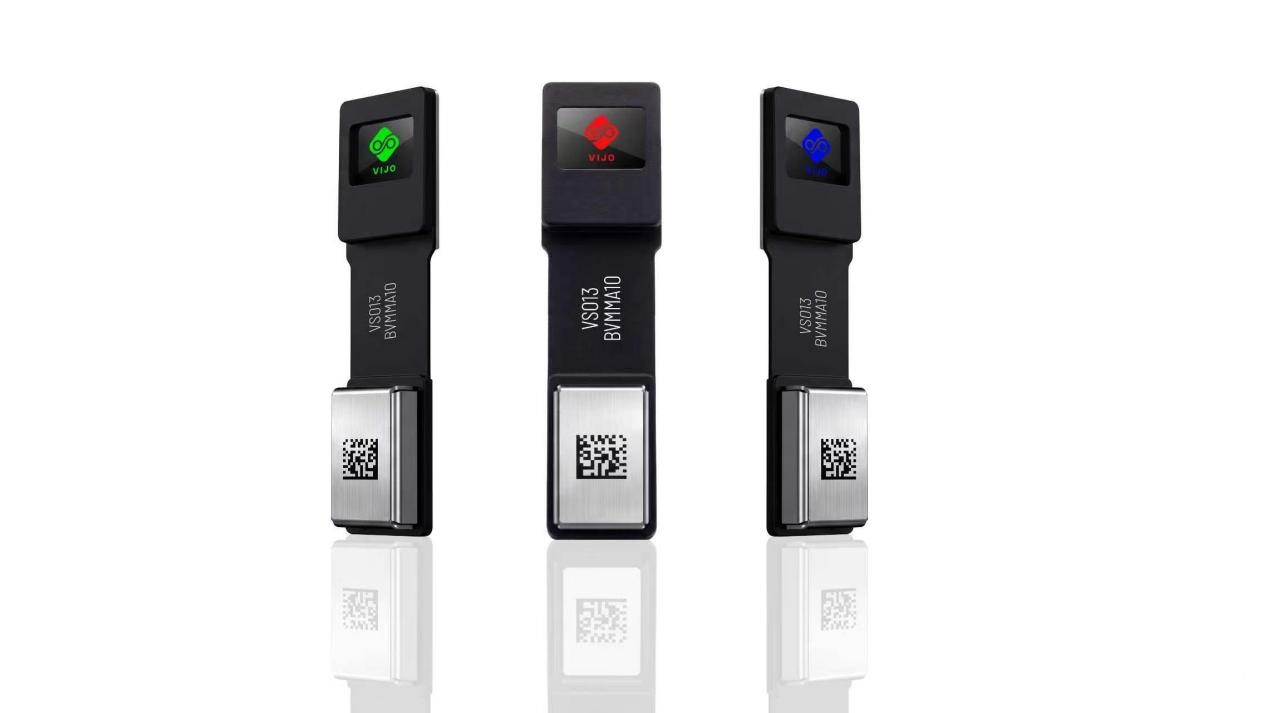
VIJO’s 0.13-inch LEDoS microdisplays
Dr. Wang said that VIJO, as one of the youngest start-ups in the industry, has successfully accomplished in just two years what typically requires a decade of technical development from established peers. The company has now achieved volume production and shipments, with its core product line centered on 0.13-inch monochrome green LEDoS microdisplays featuring a pixel pitch of merely 4μm, a resolution of 640×480, and a high pixel density of 6,350 PPI. Notably, the product delivers a peak brightness of 6-7 million nits, an outstanding performance that fully meets the user requirements of AR glasses under various complex lighting conditions.
VIJO’s 0.13-inch monochrome green LEDoS microdisplays are fabricated on 12-inch CMOS backplanes. First, advanced processes are typically designed for the 12-inch wafer node. Second, a single 12-inch CMOS backplane can be bonded with seven 4-inch LED epiwafers, demonstrating its exceptional cost efficiency.
With outstanding performance, this solution has been adopted by downstream AR glasses suppliers. Meanwhile, an increasing number of major customers are accelerating product validation.
Accelerate capacity expansion and proactively reserve core new technologies
With a bullish outlook on the future boom in the AR glasses market, VIJO has planned to build a new epitaxy production line in Beijing, slated to enter production in January 2027. Once online, this facility will enable VIJO to achieve independent in-house capabilities and continuous advances in red LED epitaxy technology. The company will also gain a stronger footing in the full-color display LED market, working alongside its customers toward the full-color AR glasses era.
To achieve cutting-edge innovations, single-panel full-color LEDoS microdisplays have become a core strategic focus in VIJO’s roadmap, as they effectively reduce the volume and weight of AR glasses. The company said it has leveraged single-panel full-color solutions based on a stepped structure to effectively prevent interference among RGB emitters, thereby ensuring uncompromised display performance.
Looking toward future deployment, VIJO noted that LEDoS technology promises to make strides in a wide range of applications. The company is simultaneously doubling down on its AR glasses leadership while actively branching into diverse application domains, such as automotive display systems and optical communications.
Outlook
For LEDoS microdisplays, pixel pitch represents a mission-critical performance metric. Pixel pitch reduction not only enables microdisplay miniaturization while maintaining or even enhancing resolution, but also serves as the cornerstone of field of view (FOV) expansion in AR glasses.
Looking ahead, VIJO has outlined a technology roadmap that advances toward smaller pixel pitches from the current 4μm to 3μm, and subsequently to 2.8μm and 2.5μm, breaking through industry-wide limitations. At the same time, the company will build a strong technological moat by covering the entire stack of epitaxy and all processes, and is committed to becoming an industry leader in LEDoS micro-display technology.
TrendForce 2025 Near-Eye Display Market Trend and Technology Analysis
Publication Date : 29 August 2025
Language : Traditional Chinese / English
Format : PDF
Page Number: 168
|
If you would like to know more details , please contact:
|


